
Driveway Cleaning in Salem, Oregon: Slab, Edges, Curb Apron and Where the Rinse Goes
Driveway cleaning in Salem covers the slab, the edges where moss creeps in and the apron down at the curb. Concrete, asphalt and pavers each get their own setting. Because Salem storm drains run to creeks, the rinse goes to soil.
Sources read on 11 October 2026: three city pages, a DEQ PDF and McNary Field normals.
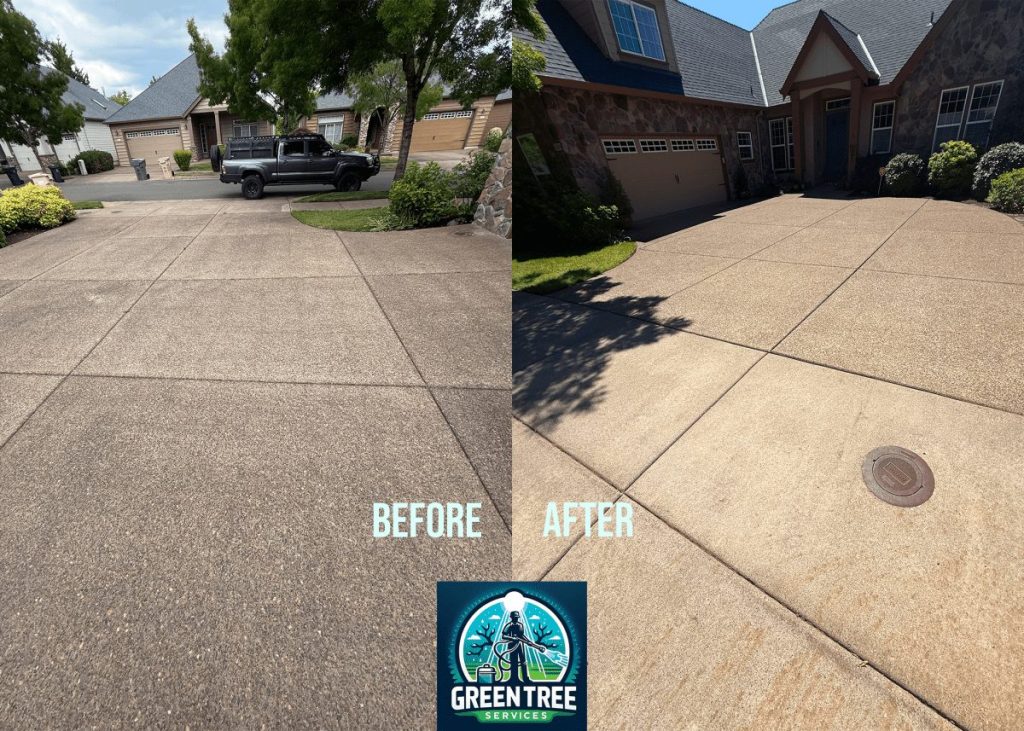
Driveway cleaning in Salem: cost, surfaces, stains and runoff in four answers
This page covers the drive alone. Steps, walks and porches sit on the concrete cleaning page, and the whole lot on the Salem hub.
What does driveway cleaning in Salem cost?
Room for two cars costs $299 to clean, edges and apron included. A walk plus a patio on the same day puts the job at $299 to $350. One setup for every slab on the lot runs $300 to $500. Thick old oil or a long apron pushes a figure toward the high end of its band.
Which kinds of drive does the Salem service take on?
Plain poured concrete, exposed aggregate, stamped concrete, pavers and asphalt. Of the five drive surfaces, plain concrete alone gets full force. Aggregate, stamped finishes and pavers get a lower setting, so stones, pattern and joint sand stay put. Asphalt, however, gets its own setting, chosen at the walk-round.
Can oil and rust marks come out of a Salem driveway?
A new drip often lifts completely, while years-old oil and rust tend to fade instead. Oil gets degreaser and a wait, and only then the rotating cleaner. Rust, however, takes an acid-based product. The quote lists any mark likely to stay faintly visible, so expectations match the result.
Where does the rinse water go after a Salem driveway clean?
Onto the lawn, gravel or a planting bed beside the drive, never into the street. According to the City of Salem, washing on a driveway can carry soap and grime into storm drains. Those drains flow directly into local waterways, where the runoff can harm fish and wildlife. Soil, by contrast, holds it.
What does driveway cleaning in Salem include, from garage door to curb?
The full slab, every edge and joint, and the apron that slopes down to the curb. The visit opens with a dry sweep, then degreaser on oil marks. Next, the rotating cleaner covers the slab in overlapping passes. Edges and joints get a closer pass when moss has crept in.
- The main slab. Passes overlap panel by panel, so the finish dries an even colour with no stripes.
- Edges and expansion joints. Moss and grass come out of the cracks by hand before any water runs.
- The curb apron. The sloped stretch at the street gets the same passes, although nearby inlets get a cover first.
- Oil, rust and leaf marks. Each mark gets its own product before the full pass, since one product never suits all three.
- The garage threshold. Rinse water runs away from the door, so none of it ends up inside.
- Walks beside the drive. They can also join the same visit, priced on a separate line.
Which setting does each kind of Salem driveway get?
Concrete takes the most force, while every other drive surface takes less. The setting follows the material rather than the dirt, so a filthy paver drive still gets light passes. Stubborn marks get products and time instead of extra force. The table below lists each surface with its setting.
| Surface | Setting | Reason |
|---|---|---|
| Plain poured concrete | Full force, rotating cleaner | Dense slab takes force |
| Exposed aggregate | Lower setting | Keeps the surface stones seated |
| Stamped or coloured concrete | Lower setting | Protects the pattern and colour |
| Concrete pavers | Lighter passes | Sand stays in the joints |
| Asphalt | Its own setting | Chosen at the walk-round |
Sealing, crack filling and asphalt resurfacing sit outside the service, so a paving contractor handles them.
Which marks show up on Salem driveways, and which ones come out?
Oil drips, rust spots, green film along the edges and brown leaf shadows under trees. Each one needs its own product, and some only fade. Quick action on a fresh drip helps the most. For spills, the City of Salem suggests an absorbent such as kitty litter, swept into the garbage afterwards.
- Oil and grease. Degreaser sits on the mark for a while, because plain water slides straight off oil.
- Rust. Rust spots take an acid-based product rather than degreaser, and deep ones may only lighten.
- Edge growth. Moss along edges and joints comes out by hand and broom before the wash.
- Leaf shadows. Fallen leaves stain concrete brown with tannin, so those marks get their own product.
The city car care page also asks for quick leak repairs. Drip pans or tarps catch the rest. Otherwise, a leaking car simply marks the clean slab again.
Why does a Salem driveway clean keep rinse water out of the street?
Salem storm drains empty into creeks, untreated, so street runoff becomes creek water. The city stormwater page says runoff from hard surfaces carries pollutants downhill into a stream. Soapy rinse water would follow the same path. So every rinse heads onto lawn, gravel or planting beds instead.
The city stormwater page names streets, parking areas and rooftops as the hard surfaces in question. Water on them does not soak in, so it runs off and gathers whatever lies on top.
Each summer, the city also marks 100 storm drains with the words Dump No Waste, Drains to Creek. The drain marking page adds that anything entering a drain reaches nearby creeks without treatment.
The apron needs the most care, because it slopes straight toward the gutter. Any inlet near the curb therefore gets a cover before the first pass.
The Oregon DEQ washing practices even list driveways by name. They ask that heavy debris come off by dry sweeping before any wash begins.
When should a Salem driveway get cleaned?
Late summer into September suits most drives, because slabs dry fast and leaves have not yet fallen. McNary Field normals give 0.39 inches of rain for August and 1.46 for September. October then climbs to 3.47 inches, and November to 5.95. A September clean therefore clears summer grime before the slick months.
| Month at McNary Field | Inches of rain | Days with 0.01 inch or more | What it means for a drive |
|---|---|---|---|
| August | 0.39 | 3.2 | Driest of the four |
| September | 1.46 | 6.4 | Still dry, before leaf fall |
| October | 3.47 | 12.5 | Rain returns on about 12 days |
| November | 5.95 | 17.7 | Rain on more than half the days |
The NOAA monthly normals for 1991 to 2020 supply every number here. Shade changes the picture, so a drive under big trees may turn green sooner than an open one.
Driveway cleaning prices in Salem for one, two or every slab
The valley price list covers Salem, so these bands match Corvallis exactly.
| Job | Price | What moves it |
|---|---|---|
| Two-car driveway | $299 | Climbs with old oil and wide edges |
| Driveway, walks and patio | $299 to $350 | Depends on how many slabs join |
| All flatwork, one setup | $300 to $500 | Follows total square footage |
A drive priced alone still earns the bundle discount if two more services join the day, from 10% up to 25%.
A Salem driveway visit, step by step, from garage door to curb
The order matters, because a clean slab should never collect grit from the edges afterwards.
Clear the slab
Cars, bins and pots come off the drive before the date, so every panel is reachable.
Sweep and pull edge growth
A dry sweep lifts grit, while moss comes out of the joints by hand.
Treat each mark
Degreaser goes on oil, but rust gets its own product.
Run the rotating cleaner
Overlapping passes cover the slab first, then the apron down to the curb.
Rinse toward the lawn
The last rinse heads to soil, and then you walk the drive with the crew.
Most two-car drives take one to two hours from the first sweep. Heavy oil or a long apron, however, adds time.
Who should book driveway cleaning in Salem, and who needs a different trade?
Book it when the drive is sound but grey, green, stained or slick. A different trade comes first when slabs heave, cracks widen or asphalt crumbles. No wash repairs damage like that. Any such problem shows up at the walk-round, before a single figure goes down.
A good fit:
- Owners preparing a house for sale, because the drive sits right at the street.
- Households with a drip from a car, once someone fixes the leak itself.
- Drives under trees that turn green each winter, when edges hold moss.
A poor fit:
- Sealcoat jobs, which GreenTree leaves to paving firms.
- Heaved panels from tree roots, since they need a concrete contractor first.
- Crumbling asphalt, because water cannot hold a failing surface together.
Eight readings behind every Salem driveway figure
Each reading moves the written figure up or down within its band.
- Surface. The pressure then follows the surface, whether concrete, aggregate, stamped, pavers or asphalt.
- Size. Two cars or four, the square footage sets the base.
- Oil and rust. Old marks get a note when they may only lighten.
- Edges and joints. Thick moss along the cracks takes extra hand work.
- Apron and slope. A steep apron toward the street needs more care with water.
- Inlets nearby. Any storm drain close to the curb gets a cover on the day.
- Tap and parking. A close outdoor tap and room for the truck speed setup.
- Cars and clutter. Cars, bins and pots need a new home before the day starts.
Which pages cover the rest of the lot?
The Salem hub prices the whole lot, while single-surface pages go deeper. Steps, walks, porches and garage aprons sit on the concrete page. Patios and their pavers also have a page. Heavy flatwork and block walls belong to the power washing page.
The Salem pressure washing hub handles roofs, walls and gutters. Then see concrete cleaning, patio cleaning and power washing in Salem. Outside the city, the Oregon driveway cleaning page covers the wider valley.
What customers say
5.0 on Google. Read them all →
My driveway and back patio had not been cleaned in years. Both were so bad they looked black. By the time Green Tree was done both looked almost brand new. I would highly recommend and will use them again in the future.Diane M.
These guys are awesome, great attitude and I was completely impressed with the job they did at my new house. Will definitely be using them again and again.Jeff M.
Eight driveway questions: stains, asphalt, pavers, aprons and runoff
Short answers for Salem owners with a drive that has gone grey, green or spotted.
How often should a Salem driveway get cleaned?
Most drives need it when green film, grime or new stains show, rather than on a fixed cycle. A drive under big trees usually turns green sooner than an open one. Late summer suits most lots, because slabs dry quickly before the leaves fall. Oil drips, however, are easiest to lift while fresh.
Can you clean an asphalt driveway?
Yes, although it gets its own setting, chosen at the walk-round. The wash lifts grime, moss and loose debris from the top layer. Sealcoating, patching and resurfacing belong to a paving contractor, so the quote leaves them out. Weeds in the cracks come out by hand first.
Will cleaning a paver driveway wash out the joint sand?
Lighter passes keep most of it in place, because full force is what pulls sand from joints. Old or sunken joints may still lose a little. Low joints go on the walk-round notes ahead of pricing. Topping up the sand afterwards is a separate job, and the quote says who handles it.
What should I do about an oil drip before the visit?
Cover it fast with kitty litter or a similar absorbent, which is the City of Salem tip. Sweep the used material into the garbage, never into a drain. Then get the leak repaired, or the stain simply returns after the wash. On the day, degreaser handles whatever remains.
Does the curb apron count as part of the driveway?
Yes. The apron joins the street at the curb, and it gets the same passes as the slab. Because it slopes toward the gutter, any inlet nearby gets a cover first. Grit from the apron then comes up dry rather than washing into the street.
Why do driveway edges turn green first?
Edges and joints hold soil, water and shade longer than the open slab. Moss and green film settle there first, then creep inward. Removal starts by hand, pulling growth from the cracks before any water runs. A broom pass follows, and then the rotating cleaner finishes the slab.
Can soapy driveway water go into the street drain?
Salem guidance points away from it. The city says soap and grime from driveway washing reach storm drains, which flow directly into local waterways. State DEQ guidance prefers soapy wash water soaking into the ground over any drain. On every Salem driveway, the crew therefore sends the rinse to lawn, gravel or beds.
How long does driveway cleaning in Salem take?
Plan on one to two hours for a two-car drive, from sweep to final rinse. Heavy oil, wide edges or a long apron can stretch that. Walks and a patio added to the same day lengthen the visit further. Each surface appears on the written quote, so the scope is clear before the date.
Ready to see the drive priced?
Tell us the surface and roughly how many cars fit, and a written figure follows the walk-round. Most drives then land on a route day within a week or two.
GreenTree Services, 1460 NW Van Buren Ave, Corvallis, OR 97330 · (971) 280-2861 · Oregon Registry #2424331-91
Sources: City of Salem stormwater. City of Salem environmentally friendly car maintenance. Salem storm drain volunteer program. DEQ washing guidance PDF, 1998. NOAA CSV, Salem station USW00024232. Verify Registry #2424331-91.