
Commercial Pressure Washing in Oregon
Quoted against a written scope with building count and area, not a figure guessed from the kerb. Certificate of insurance before the crew arrives, work scheduled around your trading hours, and photographs supplied per building so a board or an owner can see what they paid for. Storefronts, offices, apartment complexes, HOA common areas and multi-property portfolios across the Willamette Valley.
Last reviewed 13 September 2026 by GreenTree Services, Corvallis. Prices, pressures and coverage below get re-checked against live operations before each republish.
On this page
- What do commercial pressure washing services include?
- What is commercial pressure washing?
- How is commercial pressure washing quoted?
- Do you provide a certificate of insurance?
- Do you document the work for boards and owners?
- Why does commercial frontage need regular cleaning?
- What does commercial building washing cover?
- The five steps on every property
- Why is one bid cheaper than another?
- What is usually missing from a cheap commercial bid?
- Do you do HOA gutter cleaning and property management cleaning?
- Do you handle apartment complexes and HOA properties?
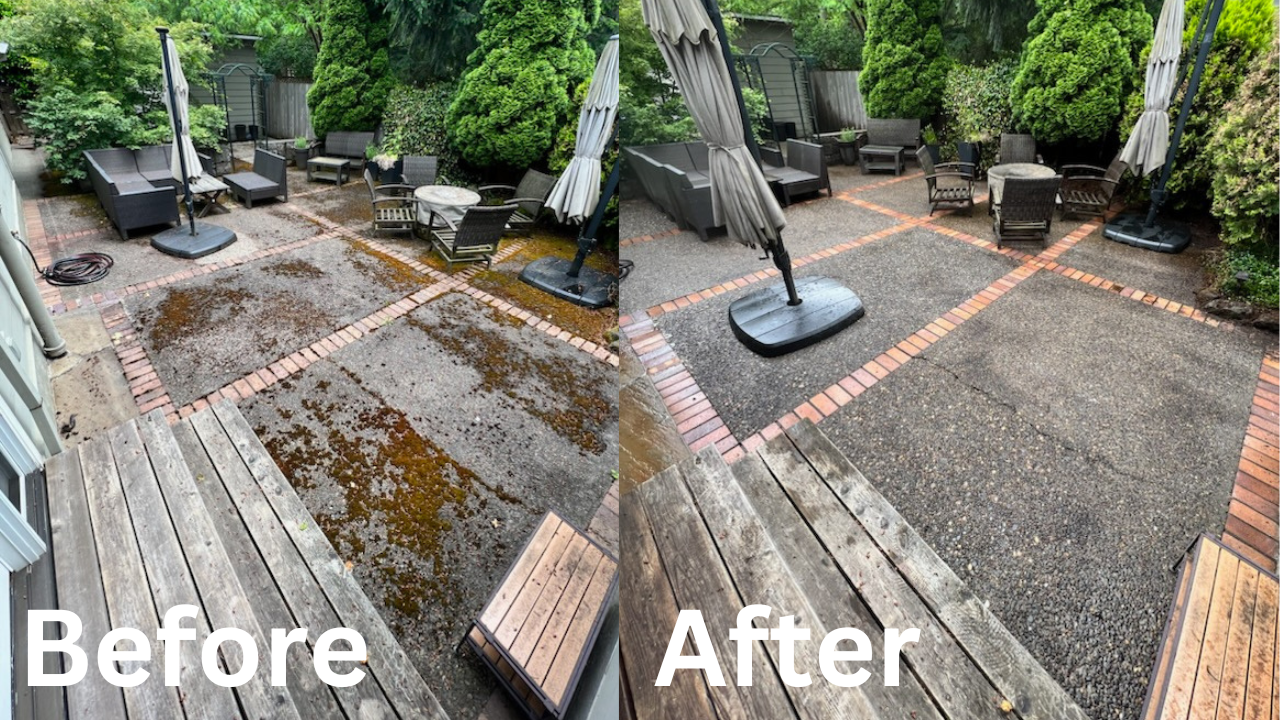
What do commercial pressure washing services include?
A property manager needs three things a homeowner never asks for. Most exterior companies are set up to deliver none of them.
What is commercial pressure washing?
Commercial pressure washing is the scheduled exterior cleaning of a business, multifamily or HOA property, priced against a written scope and delivered with insurance documentation and photographic evidence. It differs from residential work in five ways:
- Priced from a scope document rather than a verbal figure
- A certificate of insurance is issued before mobilisation
- Work is timed to trading hours or resident access, not to the crew
- Run-off is contained, because commercial volume triggers DEQ rules
- Photographs are supplied per building for boards and owners
Furthermore a recurring contract holds the figure across the term, which a one-off residential quote never has to do.
How is commercial pressure washing quoted?
Against a written scope rather than a walk-and-guess figure. The scope lists building count, surface area, frequency, access windows and exactly which elevations and surfaces we cover. Consequently the price does not move between years unless the scope does, which is exactly what a board needs when the number goes into a budget. Commercial pressure washing near me searches land here from across the valley. Storefronts typically run $250 to $600. We price portfolios per contract.
Do you provide a certificate of insurance?
Yes, on request and before the crew arrives. GreenTree carries $2 million in general liability plus workers compensation. Most property managers need the certificate on file, and many need to be named as additional insured, which we arrange for them. Above all, an uninsured contractor on your property transfers the risk of a fall or damage straight to the owner. That is the one question worth asking before price comes up at all.
Do you document the work for boards and owners?
Yes, per building rather than per job. We supply before and after photographs building by building, which matters when a board has to justify a maintenance spend or an owner is reviewing an invoice remotely. Furthermore we photograph anything we find, such as failing flashing or a blocked drain, and report it in writing rather than mentioned in passing to whoever happened to be on site.
Why does commercial frontage need regular cleaning?
A slip claim is what regular cleaning is actually insuring against, so frontage maintenance is a liability control as much as an appearance one. Algae on a walkway holds water, and a slick commercial entrance through an Oregon winter is a claim waiting to happen. Regular cleaning costs less than the incident. Moreover a documented maintenance schedule is useful evidence that the property was being actively looked after, which is a different conversation to having no record at all.
What does commercial building washing cover?
Each surface takes a different method. The pressure that cleans a loading bay would destroy the siding twenty feet away.
| Surface or area | Method | Typical cycle |
|---|---|---|
| Storefront and entryway | Flatwork at 2,500 to 4,000 PSI, glass and frames by hand | Monthly to quarterly |
| Building elevations | Soft wash under 500 PSI, matched to cladding | Annual |
| Commercial roof | Soft wash under 500 PSI, drains checked first | Every 2 to 3 years |
| Commercial gutter cleaning | Hand cleared, flushed and flow tested | Annual, twice under trees |
| Parking and walkways | Surface cleaner, run-off contained | Annual to biannual |
| Dumpster pads and loading | Hot detergent, contained run-off | Quarterly |
| Breezeways and stairwells | Low pressure, timed around residents | Annual |
| Carports and mailbox areas | Mixed, by surface | Annual |
commercial roof cleaning · commercial soft washing · dumpster pads · apartment complexes · graffiti removal
The five steps on every property
Step two is where most exterior companies fall over, because paperwork is not what they are set up to produce.
Site walk and written scope
Building count, surface area, elevations, access constraints and frequency documented, then priced against that scope.
Paperwork before mobilisation
We issue the certificate of insurance, arrange additional insured where required, and agree access windows in writing.
Scheduled around occupancy
We time work to trading hours or resident access, usually early morning, so walkways dry before footfall starts.
Clean to the surface
Flatwork at 2,500 to 4,000 PSI, siding and roofs under 500. Run-off contained rather than rinsed to the storm system.
Document per building
Before and after photographs supplied per building, with anything found reported in writing for the board or owner.
Why is one bid cheaper than another?
Bids here diverge far more than residential quotes, and almost always because the scopes are not describing the same job.
What is usually missing from a cheap commercial bid?
The scope document itself. Without one there is nothing defining which elevations, which surfaces or how often, so two numbers that look comparable are pricing different work. Insurance is the second gap, because a contractor without cover is cheaper for an obvious reason. Run-off containment is the third, and on commercial flatwork the volume is high enough that rinsing to the storm drain is a regulatory problem rather than an untidy habit.
| Our standard | What commonly happens instead |
|---|---|
| Written scope with building count and area | A verbal figure, so nobody can tell what was excluded until it is skipped. |
| Certificate of insurance before mobilisation | No cover, so a fall on your property becomes the owner’s claim. |
| Photographs supplied per building | No record, leaving a board to approve an invoice on trust. |
| Run-off contained on flatwork | Volume straight to the storm drain, against Oregon DEQ rules. |
| Pressure matched per surface | One setting from the loading bay to the cladding, which damages both. |
| Timed so walkways dry before footfall | Wet entrance during trading hours, which is the slip risk you were fixing. |
| Fixed contract price across the term | Figure creeps annually with no change in scope to justify it. |
None of this is expensive to provide. It is administrative, and a crew that only works residentially has never had to build it. Scoping properly is why the contract figure holds and why the renewal conversation is short.
Do you do HOA gutter cleaning and property management cleaning?
Property management cleaning splits three ways. Three buyers, three different pressures. The work is similar. What they need from a contractor is not.
Do you handle apartment complexes and HOA properties?
Yes, and multifamily is quoted by building count rather than by total area. The work covers siding, breezeways, stairwells, walkways, carports, mailbox areas and common roofs. Scheduling works around resident parking and access. Recurring annual or biannual contracts are the usual arrangement here, because common areas degrade on a predictable cycle and reacting to complaints always costs more than staying ahead of them. See property manager services.
Do you offer recurring maintenance contracts?
Yes, and most commercial clients move to one after the first visit. A recurring schedule costs less per visit than one-off calls, keeps the property on a known cycle instead of reacting to complaints, and holds the budget figure steady. We run annual, biannual and quarterly schedules depending on footfall and exposure. See contract terms.
Where do you offer commercial pressure washing near me?
No trip fee inside the service area. Portfolios spanning several cities are scheduled together to keep mobilisation down.
Coverage and ZIP codes: Corvallis 97330 and 97333, Albany 97321 and 97322, Eugene 97401 to 97405, Springfield 97477 and Salem 97301. Commercial frontage clusters downtown in each: Monroe Avenue in Corvallis, First and Second Avenue in Albany, and the Coburg Road and Oakway corridors in Eugene.
Cities
By service
Our five specialties
What commercial exterior cleaning costs in Oregon
Quoted per surface and per building, scheduled around your trading hours. Recurring work is priced per visit with the breakdown left visible.
| Service | What it covers | Price |
|---|---|---|
| Storefront and entry approach | Flatwork plus the glass-adjacent surfaces | $250 to $400 |
| Building exterior, single-storey | Soft washed | $250 to $500 |
| Building exterior, multi-storey | Reach equipment required | $400 to $900 |
| Parking areas and loading zones | Priced by area and staining severity | $300 to $600 |
| Drive-through and service lanes | Traffic film and grease | $250 to $600 |
| Dumpster pads and back-of-house | Degreasing with containment | $250 to $500 |
| Gutters and roofline, per building | Usually added to a building wash | $150 to $300 |
| Recurring schedule | Set dates, per-visit pricing | Quoted per site |
Every commercial quote is broken out per surface. A single lump sum cannot be compared against last year or scrutinised by anyone above you, so ours never arrives that way.
Booking several services together earns a bundle discount of 10% to 25%, scaled by how many are on the job. The Oregon cost guide carries every range we publish.
What Oregon customers say
5.0 across 30+ reviews. Read them all →
★★★★★
I highly recommend this company for their professionalism in the excellent quality of their work, attention to detail, customer service, dependability, conscientiousness, and personal integrity.Pam G.
★★★★★
Green Tree Services did an excellent job. Efficient. Professional. High quality. Reasonable price. Highly recommend.Lisa R.
★★★★★
GreenTree Services did a great job for us! Quick, efficient, and friendly. Give them an opportunity to show you what they can do for you!Michael S.
Frequently asked questions
Ten questions, each mirrored in the FAQ schema on this page.
How is commercial pressure washing quoted?
Against a written scope rather than a walk-and-guess figure. The scope lists building count, surface area, frequency, access windows and exactly which elevations and surfaces we cover. That way the price does not move between years unless the scope does, which is what a board or an owner needs when the number goes into a budget. Storefronts typically run $250 to $600. We price portfolios per contract.
Can you work outside our trading hours?
Yes, and we schedule most commercial work that way. Storefronts and offices are usually done early morning before opening. We schedule apartment complexes and HOA properties around resident parking and access rather than around our own convenience. We time anything involving wet walkways so surfaces dry before footfall starts.
Do you provide a certificate of insurance?
Yes, on request and before the crew arrives. GreenTree carries $2 million in general liability plus workers compensation. Most property managers keep the certificate on file, and many ask us to name them as additional insured, which we arrange. An uninsured contractor on your property transfers the risk of a fall or damage straight to the owner.
Do you document the work for boards and owners?
Yes. We provide before and after photographs per building rather than per job, which matters when a board has to justify a maintenance spend or an owner is reviewing an invoice remotely. We photograph anything we find, such as failing flashing or a blocked drain, and report it in writing rather than mentioning it in passing.
Do you clean dumpster pads and service areas?
Yes. Dumpster pads, loading areas, grease-affected flatwork and service corridors are standard commercial work and need hot detergent rather than water alone. We contain run-off rather than rinsing it to the storm drain, which matters more on commercial flatwork because the volume is higher and Oregon DEQ regulates discharge to the storm system.
Do you handle apartment complexes and HOA properties?
Yes. Multifamily and HOA work spans siding, breezeways, stairwells, walkways, carports, mailbox areas and common roofs. We price by building count against a written scope and schedule around resident access. Recurring annual or biannual contracts are the usual arrangement because common areas degrade on a predictable cycle.
Why does commercial frontage need regular cleaning?
Liability as much as appearance. Algae on a walkway holds water, and a slick commercial entrance through an Oregon winter is a claim waiting to happen. Regular cleaning costs less than the incident. A documented maintenance schedule also gives useful evidence that somebody was looking after the property.
Can you clean commercial roofs?
Yes, by soft wash under 500 PSI, the same method used residentially. Commercial roof cleaning covers composition, membrane, metal and tile. On flat and low-slope roofs we check drainage and membrane seams before any water goes down, because a blocked commercial drain turns a clean into a leak.
Do you offer recurring maintenance contracts?
Yes, and most commercial clients move to one after the first visit. A recurring schedule is cheaper per visit than one-off calls, it keeps the property on a known cycle instead of reacting to complaints, and the budget figure stays predictable. Annual, biannual and quarterly schedules are all available depending on footfall and exposure.
Which Oregon cities do you cover commercially?
The Willamette Valley is our standing route: Corvallis, Albany, Eugene, Springfield, Salem, Philomath and Lebanon across Benton, Linn, Lane and Marion counties, with no trip fee. The Portland metro area is served on scheduled routes. We schedule multi-property portfolios spanning several of those cities together, which keeps mobilisation down.
Request a scoped quote
Site walk, written scope, certificate of insurance. We reply within 2 hours on any working day, Mon to Sat 7am to 7pm. Multi-property portfolios welcome.
GreenTree Services, 1460 NW Van Buren Ave, Corvallis, OR 97330 · (971) 280-2861 · Oregon Registry #2424331-91
Sources and standards: Oregon DEQ stormwater rules · OSHA ladder safety · ARMA · NOAA rainfall data · Verify Registry #2424331-91