
Driveway Cleaning and Pressure Washing Service in Oregon, Set by the Concrete Under the Dirt
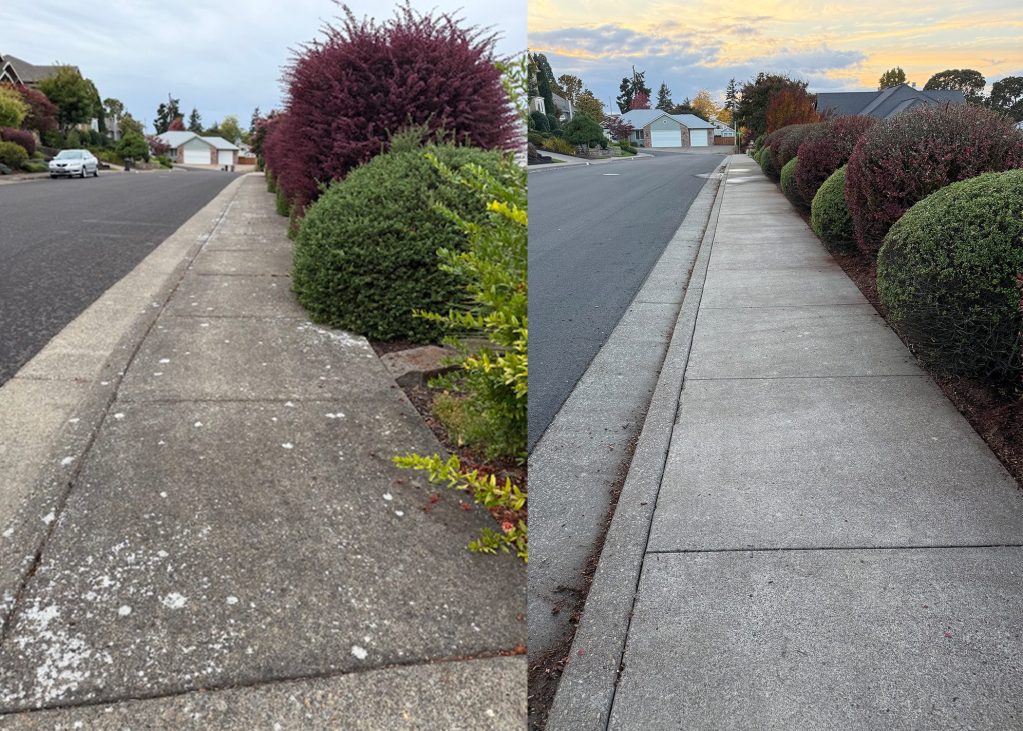
Our driveway cleaning and pressure washing service in Oregon starts by reading the concrete, since each finish caps the pressure. A plain broom-finished slab handles full pressure under a spinning surface cleaner. Pavers, exposed aggregate, stamped work and frost-scaled patches all get less. A two-car driveway costs $299, and every hard surface on the lot runs $300 to $500. Both figures go in writing before a hose comes off the truck.
Checked 27 September 2026 beside the five driveway city pages, NRMCA frost guidance and DEQ washing rules.
On this page
Three straight answers before you book a driveway cleaning service in Oregon
Price, stripes and oil decide how a clean turns out, so those three come first.
How much does driveway pressure washing cost in Oregon?
In Oregon, driveway pressure washing for a two-car slab costs $299 on our route. With the front walk and a patio included, expect $299 to $350. Put every paved surface on the property into one visit, and it costs $300 to $500. Pavers, deep oil and frost scaling each add time, moving a quote up its band.
Siding, roofs, gutters and decks also carry their own bands on the Oregon cost guide. Whatever the job, our driveway cleaning service in Oregon puts the figure in writing first.
Why do some Oregon driveways come back with stripes?
Stripes mean an Oregon driveway cleaning service ran a handheld wand over the whole slab. A wand throws a narrow fan, and no arm holds it level across a driveway. Each pass then cleans more or less than the last, and the slab dries in bands. A rotating surface cleaner avoids this, holding every nozzle at one height.
Can oil stains come out of an Oregon driveway?
On an Oregon driveway, fresh oil drips mostly lift with a pressure washing service, whereas years-old oil only fades. Motor oil is a hydrocarbon, so plain water beads on it. Our rig runs cold water only, which means degreaser does the dissolving, and it needs time on the stain. Old oil, however, has already wicked deep into the pores.
The quote thus names the likely result for each stain before you book, rather than after the work.
What does a driveway cleaning and pressure washing service in Oregon include?
The slab, its joints, its stains and the ground around it, each handled in a set order. First, the joints come clear by hand and degreaser goes onto oil. The surface cleaner then covers the open field. Outside the concrete, planting sits under covers, rinse water drains into soil, and photographs capture both states.
Work on the concrete itself
- Loose debris off first. Leaves, needles and grit come off dry, since a spinning head would only grind them into paste.
- Joints picked out by hand. Hand tools clear moss, grass and silt from each saw cut and expansion joint.
- Degreaser on every oil mark. It sits on each drip while the rest of the setup goes on, because the water stays cold.
- Surface cleaner across the open field. Overlapping rows at one steady height leave no wand bands behind.
- Wand work at the margins. Garage lips, curb aprons, step faces and the strip along the lawn take the wand last.
Work around the driveway
- Cars off, smaller things moved. You move the cars, while the crew shifts bins and pots and puts them back afterwards.
- Beds soaked and covered. Planting beside the slab takes clean water first, then a cover while degreaser sits nearby.
- Rinse steered onto soil. Wash water heads for lawn or beds instead of the inlet at the curb, as DEQ guidance asks.
- Problem outlets flagged. A downspout or sprinkler that soaks one corner keeps it green, so the quote points it out.
- Photographs from fixed spots. Before and after shots from the same corners let you compare like with like.
Choosing a driveway cleaning service in Oregon: oil, green film and the public walk
Can a driveway cleaning service in Oregon lift old oil stains?
Fresh drips usually lift, while oil soaked in over several years only lightens. Degreaser goes on every mark as part of the $299 two-car clean. Because the water runs cold, it needs dwell time before the surface cleaner passes. Our driveway cleaning service in Oregon names the likely result for each stain before you book.
Why does my shaded slab need a driveway cleaning service in Oregon so often?
Rain frequency matters more than volume. Salem sees 40.08 inches spread over 147.9 days, and Corvallis 43.04 inches over 167.5. A shaded slab rarely dries between storms, so green algae film settles in. Most open drives suit a yearly driveway cleaning service in Oregon, while north-facing slabs under fir often need 2 visits.
Will a driveway cleaning service in Oregon also wash the public sidewalk out front?
It can. Drive, front walk and patio together run $299 to $350. Portland City Code 17.28.020 puts sidewalks, curbs and driveways on the abutting owner. Salem, by contrast, maintains walks built before 1992 until they meet its standard. Our driveway cleaning service in Oregon restores grip on that walk. A lifted panel, though, goes to a concrete contractor first.
Which Oregon driveway surfaces take full pressure, and which take less?
Flatwork covers several materials, and the setting that suits one can ruin the next.
A broom finish is the ridged texture a stiff broom drags across fresh concrete for grip. The NRMCA scaling guide calls a broom finish adequate for most exterior surfaces. That ridged texture also handles full pressure well. Exposed aggregate means a finish where the gravel shows at the top. Each stone holds on through a thin ring of cement paste, so hard spray loosens the edges first.
| Surface | Setting | Main risk |
|---|---|---|
| Broom-finished poured slab | Full pressure | Wand banding that shows in low sun |
| Exposed aggregate | Lower end, head kept moving | Stones working loose along the slab edges |
| Stamped or colored concrete | Reduced, since a coating usually sits on top | Coating and tint lifting away together |
| Interlocking pavers | Lower end, then joints refilled | Blocks rocking once their joint sand drains away |
| Flagstone on sand or mortar | Reduced, stones worked by hand | Gaps opening as bedding sand or mortar leaves |
| Frost-scaled or flaking slab | Lowest setting, slower passes | Weak surface mortar peeling further |
| Steps and thresholds | Wand, worked by hand | Riser edges, where most trips start |
| Commercial lots and walks | Full range, rinse contained | Heavy run-off heading for inlets |
Frontage walks have their own sidewalk cleaning page, while business lots sit on the commercial concrete cleaning hub. For the rest of the property, see the pressure washing hub.
Which stains mark Oregon driveways, and why does each need its own method?
A stain is either a film on top or a mark inside the pores, and that split decides the method.
Oil and fuel where the car parks
Oil repels water, so a hose alone slides straight over it. Degreaser breaks it into droplets the rinse can carry, although only after real dwell time. Fresh drips therefore clear well. Old patches, by contrast, have wicked into the pores and usually fade rather than vanish.
Orange rust marks from iron
Rust is iron oxide, fixed inside the surface as a stain rather than a film. Iron-rich well water, fertiliser granules and steel furniture, for example, leave most of it. Pressure barely touches rust, so the quote says how far each mark should fade.
Brown leaf prints and tannin
Wet leaves leach tannin, a plant acid, into pale concrete and leave brown shapes behind. Tannin sits inside the pores, so a harder spray only opens them further. It also needs different chemistry from green film. The Eugene driveway page covers tannin in depth, since street trees there drop leaves straight onto aprons.
Green film and joint moss
Green film is algae living in the thin layer of water a shaded slab holds. It turns slick underfoot long before it looks dirty. The surface cleaner lifts the film, while hand tools pull moss from the joints. Film then returns wherever the slab stays wet, which is why shade sets the cleaning cycle.
Tire arcs and white bloom
Dark arcs at the turn are rubber, so degreaser and the surface cleaner lighten them. White powdery bloom differs completely, because it is salt that moisture carries up from inside the slab. Washing removes the powder on the day, although the slab can bloom again as it dries.
What does frost do to an Oregon driveway, and why does it change the pressure?
Frost can scale the surface, so a flaking slab takes less pressure, never more. The NRMCA guide describes scaling as small local patches that later merge across the slab. Water in saturated concrete expands as it freezes, and therefore stresses the surface. A full-force pass then strips the loosened mortar away.
The same guide even lists a high-pressure washer among the tools for removing unsound concrete before a repair. That is exactly why a cleaning crew slows down on a scaled slab. Light scaling leaves the coarse stones covered, whereas severe scaling leaves them plainly exposed.
What owners can do between cleans
Deicers matter most. NRMCA advises avoiding deicing chemicals in the first winter of a new slab, and using moderate amounts afterwards. It also says never to use ammonium sulfate, ammonium nitrate or magnesium-based salts as a deicer. Cars can also track magnesium-based road salts home and leave them on the drive, the guide warns. ODOT uses magnesium chloride on Oregon highways before and after winter storms. A spring clean thus also lifts that road residue off the apron.
Should an Oregon driveway get a sealer after pressure washing?
Sealing is a separate decision, made after the clean slab has dried right through. The NRMCA scaling guide suggests a breathable silane or siloxane sealer for slabs that face frost and deicers. That coating needs bare, dry concrete, so the clean always comes first. The driveway prices on this page cover the cleaning alone.
Instead, plan any sealer as its own job with a sealing contractor, and ask which product suits your finish. Dry weather sets that date, so summer usually suits it better than winter. A sealed slab also changes the next wash, since coated stamped and colored work takes a lower setting.
Where does rinse water from an Oregon driveway service go under DEQ guidance?
Into lawn or bed soil, well away from any street inlet. The Oregon DEQ March 1998 washing guidance covers pavement washed with detergents, soaps or cleaners. It names two outlets for that water: the ground itself, or a sanitary sewer or treatment system. Degreaser counts as a cleaner, so our rinse goes onto lawn or beds.
The same guidance also asks that paved areas lose their excess debris before any water-only wash. The crew therefore sweeps leaves, grit and needles off first, which keeps them out of the gutter too. Corvallis and Albany both say their street drains reach local streams without treatment. Each city page below adds its own local rule. Every driveway cleaning and pressure washing service we run in Oregon therefore ends with the rinse in soil.
Who looks after the sidewalk in front of an Oregon driveway?
Usually the owner of the lot behind it, although each city writes its own rule. Portland City Code 17.28.020 puts sidewalks, curbs, driveways and parking strips on the abutting owner. Salem, by contrast, splits the job by age. The city maintains walks built before 1992 until they meet its standard, while owners keep newer ones.
Salem also asks owners to keep sidewalks free of debris, vegetation, snow and ice at all times. The Portland section also adds that owners answer for injuries a defective walk causes. The Eugene and Albany rules, however, sit on those city pages below.
Cleaning restores grip and color, although it never levels a lifted panel. A repair notice therefore goes to a concrete contractor first, and the wash follows the repair.
Our Oregon driveway pressure washing service, step by step, from the first look at the slab to the last photograph
Reading the concrete comes first on every lot, because that one look fixes the setting for each slab.
Read the slab
Finish, age, scaling and each stain go on the sheet before anyone picks a setting.
Sweep and protect
Debris comes off dry, planting gets a cover, and we pick the lawn that takes the rinse.
Degrease and clear joints
Degreaser sits on each oil mark while hand tools clear the joints.
Surface clean at the right setting
The rotating head crosses sound concrete in rows, then eases off for pavers.
Hand finish and photograph
Lips, steps and joints take the wand last, then we photograph the same corners as before.
Two quotes for one Oregon driveway service: where does the gap come from?
Two quotes for the same slab can describe two different jobs, so compare what each one leaves out.
What a cut-price Oregon driveway service leaves out, from sweep to hand edges
Time, mostly: the sweep, the dwell and the hand work. A hurried visit gives degreaser no time, so oil shadows return with the first rain. It also runs one setting over pavers and scaled patches alike. Finally, it leaves the joints packed and the edges framed in grime, because a round machine cannot reach them.
| Our standard | What a rushed job does instead |
|---|---|
| Setting chosen per surface after reading the slab | One setting everywhere, so pavers lose sand and scaled patches flake. |
| Joint moss picked out by hand | Straight to pressure, with the joint moss left in place. |
| Rotating head across all open concrete panels | A wand alone, leaving bands that show whenever the sun sits low. |
| Debris swept off before any water | Leaves and grit hosed straight into the street gutter. |
| Degreaser left to work on each oil mark | Force aimed at oil, which drives the stain further into the pores. |
| Rinse steered onto lawn or beds | Rinse run down the curb toward the storm inlet, against DEQ guidance. |
| $2M insured, figure fixed in writing | No proof of cover, and a verbal number that grows on the day. |
None of those steps needs costly materials, only unhurried minutes on the slab. Line two quotes up item by item, and then any gap shows quickly.
When is the best time for driveway pressure washing in Oregon?
It depends on what marks your slab, although autumn suits most Oregon drives. A clean before the rain returns gives steps and walks their grip back for the wet months. Albany drives suit late August, after the grass seed harvest dust settles. In Eugene, slabs under street trees suit the weeks after leaf pickup. Spring then clears whatever winter left.
Mid-winter visits still work, although a slab dries slowly between showers.
Why does Oregon concrete go green so fast?
Rain frequency matters more than rain volume. Salem McNary Field, for example, sees 40.08 inches spread across 147.9 days in the NCEI 1991-2020 normals. The Corvallis State University station gets 43.04 inches over 167.5 days. From autumn to spring, as a result, a shaded slab rarely dries out between storms. A thin green film of algae then settles into the damp surface.
Concrete here never gets a long dry stretch between those wet days. North-facing slabs and drives under fir stay green longest, because the low winter sun barely reaches them.
Which slabs suit a driveway cleaning service in Oregon, and who should call a concrete contractor first?
Owners of sound concrete that simply looks wrong: green, oily, tire-marked or gray with grime. A wash restores color and grip. However, it cannot mend a slab that has cracked through, heaved over a root or started to scale badly. Those go to a concrete contractor first, and the quote tells you which applies.
When the slab needs another trade before any wash
- Heaved or broken panels. A concrete contractor resets or replaces them, and then the clean can follow.
- Severe scaling with loose stones. Resurfacing belongs to a concrete contractor, since more force would only strip more mortar.
- A sidewalk repair notice. The city repair comes first, because a wash cannot level a trip edge.
- A sealer you want applied. Instead, book the coating separately once the slab dries out fully.
- Deep old oil you need gone completely. Degreaser lightens it, and the walkthrough names the likely end result.
- A stoop on its own. Visits start at $299, so a single step rides along with larger work instead.
If repair comes first, the quote says so, and the driveway pressure washing service waits until the slab is sound.
Before any priceWhat the free quote checks on each Oregon driveway: its finish, its stains, its slope
An Oregon driveway pressure washing service starts with ten checks made on site. Finish, area and stains set most of the price. Scaling, joints and slope then adjust the method. Finally, the tap, the rinse route, the public walk and parking shape the visit itself. One written price for every surface follows next, and it holds.
| What the walk checks | Why it matters on an Oregon driveway |
|---|---|
| Finish of each slab | Broom finish, aggregate, stamped work and pavers each carry their own pressure ceiling. |
| Area | We measure drive, walks, apron and patio on the ground rather than from a photo. |
| Stains by type | Oil, rust, tannin and green film each call for a different approach. |
| Frost scaling | Flaking mortar lowers the safe setting for that whole panel. |
| Joints and edges | Soil-packed saw cuts and empty paver joints mean extra hand work first. |
| Slope and drainage | The low side stays wet longest, so it earns the slowest passes. |
| Outside tap | The rig also needs a working hose bib within reach of the slab. |
| Rinse route | We choose the lawn or bed that will absorb the wash water, so none reaches the street. |
| Public sidewalk | City rules differ, so we note whether the front walk joins the job. |
| Parking and access | We ask for an empty slab and a truck spot near enough for short hoses. |
Is driveway cleaning priced the same in every Oregon city?
Each city page below adapts our driveway pressure washing service to the ground, stains and rules of that city. Rates stay the same in every one, with no trip fee inside the service area.
ZIP codes on the route: Salem 97301. Albany 97321 and 97322. Corvallis 97330 and 97333. Eugene 97401 to 97405. Springfield 97477. Two further pages cover driveways at the Clackamas County end.
Driveway pages by city
- Corvallis: low slabs on floodplain silt loam stay damp from below, so they green first.
- Albany: century-old Monteith and Hackleman walks get dated before anyone sets the pressure.
- Eugene: brown leaf tannin under big street trees, which pressure alone never shifts.
- Lake Oswego: long approaches under mature trees across 97034 and 97035.
- West Linn: driveways throughout 97068, just south of Lake Oswego along the Willamette.
Concrete cleaning by city
Patios and related
What Oregon customers say
5.0 on Google. Read them all →
My driveway and back patio had not been cleaned in years. Both were so bad they looked black. By the time Green Tree was done both looked almost brand new.Diane M.
Green Tree Services did an excellent job. Efficient. Professional. High quality. Reasonable price. Highly recommend.Lisa R.
Very nice, respectful young men. They worked really hard! I would use them again!Jerry V.
Before you hire a driveway cleaning service in Oregon: ten questions and answers
Each answer below stands alone, so skim straight to the question that matches your slab.
How much does a driveway pressure washing service cost in Oregon?
A two-car slab sits at the $299 minimum. Our middle band, $299 to $350, adds the front walk and a patio. Our largest band, $300 to $500, pays for drive, walks, patio and steps in one go. Inside the service area there is no trip fee, and the written figure holds.
How do you fix a striped Oregon driveway?
Run a rotating surface cleaner over the entire slab, not just the dark bands. Touching up only the stripes moves the edge of the problem somewhere else. Once one even pass covers everything, the concrete weathers as a single surface. The old banding then fades over the following months.
What PSI is safe for Oregon driveway concrete?
Sound broom-finished concrete takes high pressure from a surface cleaner, the highest setting used anywhere on a property. Pavers, aggregate and stamped finishes sit lower. Frost-scaled concrete sits lowest of all. Siding, roofs and anything painted, by contrast, stay under 500 PSI.
Can you remove oil stains from an Oregon driveway?
Fresh ones, usually; old ones, partly. Because our water runs cold, degreaser has to sit before the surface cleaner passes. Drips from this year usually lift with degreaser and dwell. Oil soaked in over several years lightens, while a faint outline tends to stay. The walkthrough tells you which result to plan for.
How often does an Oregon driveway need pressure washing?
Once a year suits most open driveways, especially in full sun. North-facing slabs, drives under fir and walks that stay damp all winter often need two visits. Those fall in autumn and spring. Shade and drainage decide it far more than the age of the house does.
Do you clean Oregon patios, sidewalks and pavers too?
Yes, and bundling them with the driveway beats booking each one alone. Everything shares one setup and one tap. Paver joints hold sand, so those blocks take a softer pass. Where joints have already washed out, we re-sand them.
Do you offer commercial concrete cleaning services in Oregon?
Yes. Parking areas, walkways, loading zones and dumpster pads go onto a written scope with area and frequency. Commercial flatwork sends more water toward inlets, so we plan the rinse route before setting a date. The commercial hub covers certificates and scheduling.
Will pressure washing damage my Oregon driveway?
Pressure washing leaves an Oregon driveway unharmed when the setting matches the slab and a surface cleaner works it. A nozzle that sits too near the concrete cuts lines into the surface. Frost-scaled and older concrete get a lower setting and slower passes.
When is the best time for driveway pressure washing in Oregon?
Before the wet season suits most slabs, so steps and walks go into winter with their grip back. Local marks then set the exact week, such as harvest dust in Albany or leaf fall in Eugene. Spring works as a second date for fast-greening slabs.
Should I seal my Oregon driveway after cleaning?
Sealing an Oregon driveway after cleaning is optional, and it is a separate job. NRMCA suggests a breathable silane or siloxane sealer for concrete facing frost and deicers. Any sealer needs a clean slab that has dried right through. The figures on this page buy the clean alone, so plan the coating separately.
Get your Oregon driveway cleaning service quoted in writing
Walkthrough first, then a written, locked figure.
GreenTree Services, 1460 NW Van Buren Ave, Corvallis, OR 97330 · (971) 280-2861 · Oregon Registry #2424331-91
Sources used on this page: