
Driveway and Concrete Cleaning in Eugene, Oregon
If your concrete is stained brown rather than green, that is tannin from leaf fall, not algae. The two need opposite chemistry, and pressure cannot reach tannin because it has already soaked into the pores. Eugene carries the heaviest canopy on our route, so this is the commonest complaint here. A two-car driveway runs $150 to $250, full hardscape $300 to $500.
Last reviewed 13 September 2026 by GreenTree Services, Corvallis. Before each update we confirm the prices and methods here still match current field practice.
On this page
- Driveway power washing Eugene OR: staining, chemistry and cost
- What is the brown staining on my Eugene concrete?
- Why will not bleach remove tannin stains?
- Does pressure remove tannin staining?
- How much does driveway cleaning cost in Eugene?
- Concrete cleaning Eugene: what is actually on your slab
- The five steps on every Eugene slab
- When should a Eugene driveway be cleaned?
- Why late autumn rather than spring?
- Steep drives and sidewalk work
- Can you clean a steep South Hills driveway?
- Do you do sidewalk power washing in Eugene?
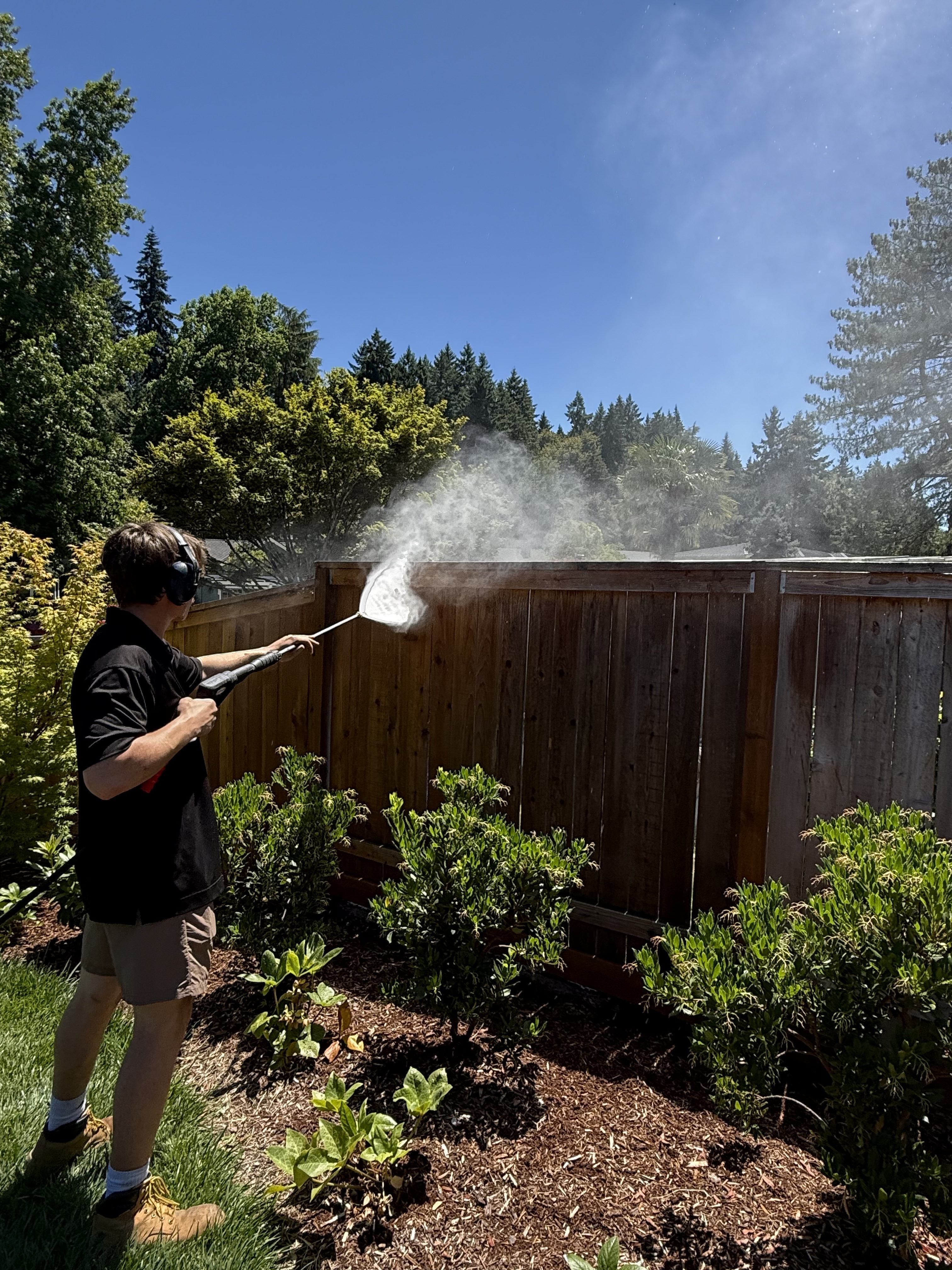
Driveway power washing Eugene OR: staining, chemistry and cost
Four questions. The first three cover one problem that most crews treat with entirely the wrong product.
What is the brown staining on my Eugene concrete?
Almost certainly tannin rather than algae. Leaves left on concrete leach tannic acid as they break down, and it soaks into the pores as a brown stain. Eugene has more canopy than anywhere else on our route. Consequently it is the commonest concrete complaint we see here. People routinely mistake it for dirt that a stronger wash would shift.
Why will not bleach remove tannin stains?
Because tannin and algae need opposite chemistry. Algae lifts with an alkaline, chlorine-based treatment. Tannin, however, is an acid stain bound into the pores. It needs an acidic product such as an oxalic-based cleaner to break it. Therefore using the wrong one does nothing at best, and sets the stain at worst.
Does pressure remove tannin staining?
No, and it usually makes things worse. Tannin has already soaked into the concrete rather than sitting on it, so force cannot reach it. What pressure does instead is open the surface pores. Consequently the remaining stain penetrates deeper. Next season’s leaf fall then stains faster than it did the year before.
How much does driveway cleaning cost in Eugene?
A two-car driveway runs $150 to $250. Adding walkways and a patio takes it to $200 to $350. A full hardscape package runs $300 to $500. Eugene sits on a scheduled route forty minutes down I-5, so there is no travel surcharge and rates match Corvallis. Full breakdown in the Oregon cost guide.
Concrete cleaning Eugene: what is actually on your slab
Six things stain Eugene concrete, and they do not respond alike. Getting this wrong is why a driveway comes back looking barely different.
| Stain | Looks like | What actually removes it |
|---|---|---|
| Tannin from leaf fall | Brown or black patches, leaf-shaped | Acidic oxalic-based product. Pressure alone does nothing. |
| Algae and mould film | Green tint, slick underfoot | Alkaline chlorine treatment with dwell time. |
| Moss in joints and edges | Green growth in cracks | Treatment at the root, then cleared by hand. |
| Fresh oil and fuel | Dark spot, still greasy | Degreaser and hot detergent before any rinse. |
| Aged oil | Grey shadow, dry to touch | Penetrated the concrete. Improvement is realistic, removal often is not. |
| Rust from fixings or furniture | Orange staining, often circular | Acidic product. The same family that lifts tannin. |
| Efflorescence | White powdery bloom | Mineral salts from within the slab. Different problem entirely. |
| Tyre marking | Black scuffing at the apron | Degreaser and surface cleaner. Usually improves rather than clears. |
General method by surface sits on the Oregon driveway and concrete hub. This page covers what changes under a Eugene canopy.
The five steps on every Eugene slab
Step one is the one that decides whether the rest of the visit achieves anything.
Identify the stain
Tannin and algae look similar and need opposite chemistry, so what is actually on the slab gets established before any product is mixed.
Plan containment for the gradient
On a South Hills slope run-off is managed before anything is applied rather than chased downhill afterwards.
Protect the planting
Beds alongside the work soaked and covered, with run-off routed onto landscaping rather than toward the Willamette drainage.
Treat to the stain type
Alkaline treatment on algae, an acidic product on tannin, and dwell time given for either to work.
Surface clean and hand finish
A rotating surface cleaner for an even slab, then edges, steps and joints finished by hand.
When should a Eugene driveway be cleaned?
The answer here differs from the standard advice, and it is the difference between preventing the stain and treating it.
Why late autumn rather than spring?
Because a wet leaf mat left on concrete through winter is what creates tannin staining in the first place. Clearing it once the leaves are down stops the stain forming rather than chasing it in April. Consequently the autumn visit is worth more on a canopy street than the spring one. That reverses the usual order. Spring remains the second window and clears whatever came through.
| How we work | What tends to happen otherwise |
|---|---|
| Stain type identified before product is mixed | Chlorine on tannin, which does nothing and can set it. |
| Acidic product used on tannin and rust | Pressure raised instead, which opens pores and deepens the stain. |
| Run-off contained before work starts on a slope | Chased downhill once it is already moving. |
| Rotating surface cleaner across the slab | Wand only, leaving bands visible in low winter sun. |
| Edges, steps and joints by hand | Machine everywhere, dirty border round a clean centre. |
| Autumn booking recommended on canopy streets | Spring only, so the stain has had all winter to bind. |
| $2M cover, certificate before we arrive | Uninsured, with a verbal figure that grows on the day. |
Carrying two chemistries costs more than carrying one. On a street with mature maples it is the difference between a driveway that comes back clean and one that comes back slightly less brown.
Steep drives and sidewalk work
Can you clean a steep South Hills driveway?
Yes, though access changes the quote more than area does. South Hills driveways frequently combine gradient, limited turning space and long hose runs. Furthermore gradient means run-off moves fast. Containment therefore gets planned before anything is applied, not once it is heading for the storm drain.
Do you do sidewalk power washing in Eugene?
Yes, and on a canopy street it is a safety job rather than a cosmetic one. Algae film combined with wet leaf residue is what makes a Eugene walkway genuinely slick from November through May. Sidewalk power washing Eugene OR properties need is usually booked with the driveway. It is one setup and one trip, so the combined figure comes down.
Eugene neighbourhoods and Springfield
Coverage and ZIP codes: Eugene 97401 to 97405, taking in Whiteaker, Jefferson Westside, South Hills, Cal Young, Santa Clara, River Road, Bethel, Churchill, Friendly and Harlow. Springfield 97477 and 97478 sits on the same scheduled route.
Concrete and flatwork nearby
Other Eugene services
More from GreenTree
What Oregon customers say
5.0 across 30+ reviews. Read them all →
★★★★★
My driveway and back patio had not been cleaned in years. Both were so bad they looked black. By the time Green Tree was done both looked almost brand new.Diane M.
★★★★★
These guys are awesome, great attitude and I was completely impressed with the job they did at my new house. Will definitely be using them again and again.Jeff M.
★★★★★
I highly recommend this company for their professionalism in the excellent quality of their work, attention to detail, customer service, dependability, conscientiousness, and personal integrity.Pam G.
Frequently asked questions
Ten Eugene questions, each mirrored in the FAQ schema on this page.
How much does driveway cleaning cost in Eugene?
A two-car driveway runs $150 to $250, adding walkways and a patio takes it to $200 to $350, and a full hardscape package runs $300 to $500. Eugene sits on a scheduled route forty minutes down I-5, so there is no travel surcharge and rates match Corvallis exactly.
What is the brown staining on my Eugene concrete?
Almost certainly tannin, not algae. Leaves left on concrete leach tannic acid as they break down, and it soaks into the pores as a brown or black stain. Eugene has more canopy than anywhere else on our route, so this is the commonest concrete complaint we see here and it is routinely mistaken for dirt.
Why will not bleach remove tannin stains?
Because tannin and algae need opposite chemistry. Algae lifts with an alkaline, chlorine-based treatment. Tannin is an acid stain bound into the pores, and it needs an acidic product such as an oxalic-based cleaner to break it. Using the wrong one does nothing at best, and sets the stain at worst.
Does pressure remove tannin staining?
No, and it usually makes things worse. Tannin has already soaked into the concrete rather than sitting on it, so force cannot reach it. What pressure does instead is open the surface pores, which lets the remaining stain penetrate deeper and makes the next season’s leaf fall stain faster.
When should a Eugene driveway be cleaned?
Late autumn once the leaves are down, which is different from the standard advice. Leaving a wet leaf mat on concrete through winter is what produces tannin staining in the first place, so clearing it before the rain sets in prevents the stain rather than treating it later. Spring is the second window.
Do you do sidewalk power washing in Eugene?
Yes, and on a canopy street it is a safety job. The combination of algae film and wet leaf residue is what makes a Eugene walkway slick from November through May. Sidewalks are usually booked with the driveway because it is one setup and one trip, which brings the combined figure down.
Can you clean a steep South Hills driveway?
Yes, though access changes the quote more than area does. South Hills driveways frequently combine gradient, limited turning space and long hose runs. Gradient also means run-off moves fast, so containment has to be planned before anything is applied rather than chased downhill afterwards.
Why do some driveways come back with stripes?
Because the crew used a wand rather than a rotating surface cleaner. A wand throws a narrow arc, so overlapping passes leave bands across the slab that show clearly in low winter sun. A surface cleaner holds a fixed circle at constant height and produces an even finish.
Which Eugene areas do you cover?
All of Eugene across 97401 to 97405, including Whiteaker, Jefferson Westside, South Hills, Cal Young, Santa Clara, River Road, Bethel, Churchill, Friendly and Harlow. Springfield sits on the same scheduled route, so both cities are usually served on one trip.
Is GreenTree insured?
Yes. GreenTree Services carries $2 million in general liability insurance plus workers compensation, and the certificate is available before the crew arrives. The company has been registered with the Oregon Secretary of State since 2022 under Registry number 2424331-91.
Get your Eugene concrete quoted
Stain identified on site, written figure, locked price, no travel surcharge. On a canopy street book the autumn visit, once the leaves are down and before the rain sets in.
GreenTree Services, 1460 NW Van Buren Ave, Corvallis, OR 97330 · (971) 280-2861 · Oregon Registry #2424331-91
Sources and standards: OSU Extension · Oregon DEQ stormwater rules · NOAA rainfall data · OSHA ladder safety · Verify Registry #2424331-91