
Deck Restoration Services Oregon: Clean, Sand, Repair, Stain and Restore
Homeowners who book deck restoration services Oregon from GreenTree get the whole job covered, from cleaning and sanding through staining, repairs and restoration. GreenTree soft washes the boards at low pressure, so the grain survives. The crew repairs soft wood itself. Stain goes on only once the timber has dried. A free written quote sets every deck price before work starts.
Checked against the USDA Forest Products Laboratory finishing guidance, Willamette Valley seasonal rainfall patterns and the GreenTree price table further down.
On this page
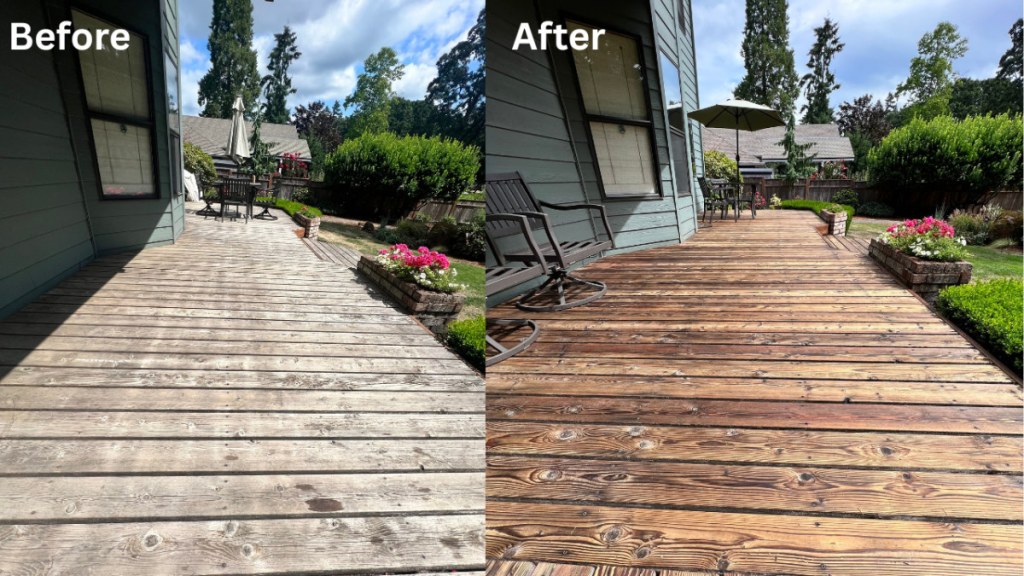
Deck restoration in Oregon: what GreenTree cleans, repairs, stains and restores
A few plain answers up front, starting with the whole scope of the work and the price that pins it down.
Do you restore and stain a deck, or only clean it?
GreenTree does all of it: a careful clean, any repairs the wood needs, then stain once the boards are dry. The clean decides whether any coating holds. Stain grips sound fiber and nothing else. We never rush the prep. Our own crew fixes soft boards, loose posts and worn sections. One team carries the deck from gray and tired to clean, sound and sealed.
Many crews stain on the day of the wash and skip the dry-down. The finish then pays for it, since stain cannot soak into boards still holding rinse water.
How much does deck restoration cost in Oregon?
Deck staining from GreenTree Services, including cleaning and sanding, runs $1,500 to $4,500, set as a free written quote before any work starts. Deck cleaning on its own runs $350 to $2,000. The full deck package, which covers cleaning, sanding, staining, repairs and restoration, typically costs about $3,000.
Wood brightening is an optional add-on that evens the tone after the clean. Railings and stairs carry labor without adding footprint, so they shape the figure as much as the square footage does.
Why does deck stain keep failing during deck restoration in Oregon?
The wood underneath was usually not ready for it. Stain grips sound fiber, not the gray layer that sun leaves behind. USDA Forest Products Laboratory finishing tests show the same pattern with paint: wood left to weather for weeks before coating shed its finish far sooner than wood coated after only a short exposure.
- The gray weathered layer, loose surface fiber with nothing holding it down
- The smooth planed face of newer boards, often called mill glaze
- An older coating that has already started to lift at the edges
A stain over any of those looks good for one Oregon winter, then peels in sheets the next. Sanding and brightening fix the first two, and a proper strip clears the third.
What pressure does GreenTree use for deck restoration on an Oregon deck?
GreenTree soft washes decks under 500 PSI, measured at the machine, rather than the up-to-4400 PSI a pressure washer can reach. Low pressure and dwell time lift the gray, so the timber grain survives the clean.
The test on the day is simple. Visible wand lines on the boards mean the pressure was wrong, and no stain hides them later. Composite boards follow the rules of their maker. Trex asks for a fan nozzle held well back from the surface and a cap on the washer, not a tight close-range jet.
Why does deck restoration in Oregon turn a deck gray and slippery at once?
Two separate problems arrive together in Oregon weather. Gray is sunlight at work: ultraviolet light breaks down the lignin that binds surface fiber, and rain washes it away. Slip is biology, because algae, mildew and moss thrive on shaded, damp boards. Summer sun does the greying, and the wet season from autumn into spring grows the film.
Mildew matters for the finish as well. The Forest Products Laboratory notes that mildew does not rot wood directly, yet it punctures a coating with microscopic holes. The OSU Extension pest guide warns that moss makes decks and walkways slippery. A deck here can be sound, gray and unsafe underfoot all at once.
What do GreenTree’s deck restoration services Oregon include?
A GreenTree deck restoration covers the boards, rails, stairs and any fence on the quote, plus the yard around them and every repair the structure needs. On the wood, a cleaner dwells, a low-pressure rinse follows the grain, and hand work reaches the railings. Our crew replaces soft boards and refastens loose rails itself. Around the deck, we cover planting and keep run-off out of storm drains. Staining follows once the boards have dried.
On the boards, rails and fence faces
- Timber check first. We look for soft boards and failing fixings before any water touches the wood.
- Repairs by our own crew. Soft boards get swapped, loose rails get refastened, worn sections get rebuilt, all in-house as part of the package.
- Cleaner with dwell time. A wood cleaner sits on the boards until it loosens the gray fiber and grime.
- Low-pressure rinse with the grain. The wand travels along each board, never across it.
- Sanding and optional brightening. We sand the surface smooth, and a brightener evens the tone before stain.
- Hand work on railings and treads. Hands and feet touch these most, so they get hand work rather than machine passes.
- Both faces of a fence. We clean posts, rails and the shaded north face, not only the street side.
- Stain on dry, sound wood. The finish waits for the dry-down, so it soaks into clean fiber.
Around the deck, the yard and the house
- Planting protected. We soak and cover the beds below and beside the deck before any cleaner goes down.
- Run-off routed. Wash water goes onto landscaping to soak in, rather than into a street drain. Oregon DEQ washing guidance asks for exactly that when detergent is in the water.
- Before and after photos. You see the same boards before the clean and after the finish, side by side.
Deck restoration in Oregon: rotten boards, peeling stain and soft cedar
Will deck restoration in Oregon cover rotten boards, or do I need a carpenter too?
Yes, our own crew replaces soft boards, refastens loose rails and rebuilds worn sections. That carpentry sits inside the full deck package, which typically costs about $3,000. So you deal with one team and one written quote, not a separate carpenter. Worn stair treads matter most in Oregon deck restoration, because they carry the most wear and slip risk.
My deck stain peeled after one Oregon winter. What does restoration do differently?
Usually it went onto gray fiber, a smooth mill-glazed face or damp wood. We sand first, and stain waits for a meter reading under roughly 15 percent. Stain over damp boards traps moisture and can fail within a single season. For Oregon deck restoration we also steer owners toward penetrating stain, since film finishes rarely stay put underfoot.
How gentle is deck restoration in Oregon on a soft cedar deck?
Our lowest setting, under 500 PSI, with the cleaner left to dwell longer. A pressure washer can reach up to 4400 PSI, which digs soft earlywood out between growth rings. The harder latewood then stands proud, and that ridge shows through any stain. Cedar and redwood get the gentlest handling in our Oregon deck restoration, rinsed along the grain.
Does GreenTree handle deck restoration in Oregon itself, or send it to a carpenter?
GreenTree repairs and restores decks itself, as part of the full deck package. Soft or rotten boards, loose posts and worn stair treads do not go to another trade. Our crew handles the carpentry, the clean and the finish on the same job, so you deal with one team and one written quote from start to finish.
This is where GreenTree differs from a crew that only owns a pressure washer. A wash-only outfit can lift the gray, then it hands you a note and leaves the broken boards for you to chase a carpenter. That split costs you two trips, two quotes and a gap in accountability. We close that gap.
What the restoration covers
- Board replacement. Spongy, cracked or cupped boards come out and sound decking goes in, matched to the rest of the deck as closely as the wood allows.
- Fastener and rail repair. Lifting screws, popped nails and a rail that moves under your hand get refastened or rebuilt so the surface is safe to walk.
- Stair and tread work. Treads take the most wear and the most slip risk, so worn ones get replaced and the whole run gets checked.
- Restoration of greyed or neglected decks. A deck that has gone years without care gets the full treatment: repair, strip, sand, brighten and stain, so it reads as restored rather than merely rinsed.
- Post and base checks. We inspect post bases and ledger lines, flag anything serious in the photos, and carry out the repair that brings the structure back.
The full deck package typically costs about $3,000 and runs the whole sequence, from cleaning and sanding through staining, repairs and restoration. Wood brightening is an optional add-on that lifts the tone further. The written quote names what the job needs before any work starts, so the price is fixed and the scope is clear.
Which method suits cedar, pressure-treated pine and composite?
Species matters more than age here. A soft cedar board and a pressure-treated pine board of the same vintage need different handling, and composite follows its own rules.
| Material | Method | What to watch |
|---|---|---|
| Cedar | Lowest pressure, longer dwell | Soft and open grained. Pressure furrows it permanently. |
| Redwood | Lowest pressure, longer dwell | Same softness, and the color goes patchy if worked unevenly. |
| Pressure-treated pine | Low pressure, standard cleaner | Harder, but the planed face of newer boards resists stain. |
| Douglas fir | Low pressure, worked with grain | Raises grain readily once the surface has weathered. |
| Composite | Low pressure, board-matched product | Does not rot, still grows the film that makes it slick. |
| Cedar fencing | Low pressure, both faces | North face greys and mosses while the sunny face looks fine. |
| Railings and balusters | Hand work | Never machine work. Most hand contact happens here. |
| Stair treads | Low pressure plus hand finish | Where the slip risk sits once the algae film sets. |
Western red cedar and redwood decks
These soft woods show every mistake. High pressure scoops out the soft earlywood between growth rings, so the harder latewood stands proud. That ridged feel survives any stain, so cedar gets our lowest pressure and longest dwell. Cedar also greys in full sun, though the gray is only skin deep and a light sand brings the warm tone back. We repair any soft cedar board before the clean, because a spongy plank will not hold a finish no matter how gently it is washed.
Pressure-treated pine decks
Treated pine is harder than cedar, so a little more pressure does no harm. Its risk sits elsewhere. Newer boards carry a smooth planed face that stain struggles to enter, and a light sanding opens that face so the finish can key in. The Wood Handbook from the Forest Products Laboratory notes that preservative-treated wood takes paint or stain once it is clean and dry.
Composite and capped decking
Composite boards do not rot, yet their textured surface holds pollen, dirt and the green film that makes them slick. Trex recommends cleaning composite twice a year, because built-up pollen and debris can feed mold. We clean composite at low pressure with a product matched to the board, not a generic wood cleaner, and we never stain it, since the cap is designed to carry its own color.
Cedar fences
Fences often look worse than the deck, since nobody walks the back. The north face stays shaded and damp, so it greys and grows moss while the sunny face still looks fine. We clean both faces along with posts and rails, and we flag or fix rot at the base while we are there. Book a fence alongside house washing or flatwork and the combined figure drops, since one setup serves both. For moss on timber, see the moss removal page.
Step by step: how GreenTree restores an Oregon deck, from walkthrough to stain
The repair step and the dwell step are where the job is won, because they are the steps a wash-only crew cannot match.
Assess the timber
First, we check species, age, old coating and any soft boards before choosing pressure, repair or product.
Protect what is below
Next, we soak and cover planting, then route run-off onto landscaping, away from drains.
Repair and restore
Then our crew replaces soft boards, refastens loose rails and rebuilds worn sections, all in-house.
Lift the gray
A wood cleaner dwells until the gray fiber loosens, so chemistry does the work, not pressure.
Rinse at low pressure
We rinse with the grain, so no furrows open between growth rings.
Sand and brighten
We sand the surface smooth, and a wood brightener can even the tone as an optional add-on.
Stain the dry boards
Finally, once the wood dries, stain goes onto clean fiber in the finish agreed at the quote.
The order matters more than any product. A clean without the dry-down wastes the stain, and a stain without the repair wastes the money, because fresh finish over a failing board fails with it. The Forest Products Laboratory favors penetrating, lightly pigmented finishes on decks, and it warns that film finishes rarely stay put on a walking surface.
What do sanding and wood brightening do for a deck?
Sanding opens the surface so stain can key in, and wood brightening evens the tone so the finish lands uniform. A clean lifts the gray, but a planed or weathered face can still shed a coating. Sanding cuts through mill glaze and raised fiber, and a brightener neutralises the clean and warms the wood back toward its natural color before stain goes on.
Deck staining from GreenTree already includes the cleaning and the sanding, which is why that service runs $1,500 to $4,500 rather than a bare wash price. The sanding is not an upsell. It is the step that makes the stain last, and it is built into the staining job.
Where each step earns its place
- Sanding after the clean. It removes the fuzzy raised grain a wash leaves behind, so the finished board feels smooth underfoot and holds stain evenly.
- Brightening as an add-on. Wood brightening is an optional add-on that lifts a dull, gray-tinged board back toward a warm, even tone, and it balances the surface chemistry after a cleaner has done its work.
- Together before stain. A sanded, brightened board drinks stain evenly, so you avoid the blotchy, patchy finish that comes from staining straight over a raw wash.
The written quote names whether a job needs sanding, brightening or both, so nothing on the estimate is a surprise. If you only want a clean, that stays a clean. If you want the finish to last, the prep is there for it.
Why is one Oregon deck quote so much cheaper than another?
On timber the cheap version is not a smaller job. It is a faster one, and the speed comes out of the boards.
What does a cheap deck restoration skip?
It turns the pressure up instead of waiting for the cleaner to work, and it leaves broken boards for you to deal with. Chemistry needs dwell time to loosen the gray layer, and dwell time costs money because the crew stands still. More pressure strips the gray in one pass and looks identical on the day. Months later, the stain peels from raised, furrowed grain, and the soft board nobody fixed keeps rotting underneath it.
| GreenTree standard | What commonly happens instead |
|---|---|
| Soft boards and loose rails repaired in-house as part of the package | Broken boards left for the owner to chase a separate trade. |
| Wood cleaner left to work on the boards before any rinse | Pressure raised to strip it in one pass, furrowing the boards. |
| Worked with the grain at low pressure, under 500 PSI | Across the grain at speed, which shows the moment stain goes on. |
| Sanded and brightened before staining | Stain rolled straight over a raw wash, so it blotches. |
| Railings, balusters and treads by hand | Machine everywhere, so contact surfaces stay filmed. |
| Both faces of a fence cleaned | Street face only, north face left gray and mossy. |
| Stain only on clean, dry boards after the dry-down | Stain rolled over damp or gray wood straight after a wash. |
| $2M insured, certificate before arrival | Uninsured work on an elevated structure. |
Why rushed crews skip the wait
The difference is patience and scope, not product. A deck prepped and repaired properly keeps its stain far longer, but that payoff stays invisible on the day of the clean. That is exactly why rushed crews skip the wait and the carpentry.
Who should book deck restoration in Oregon?
Owners of decks and fences that have gone gray, green or patchy, and owners of decks with soft boards or loose rails. If the structure just needs reviving, cleaning, sanding and staining bring the wood back. If boards are soft, a rail wobbles or a section has worn out, GreenTree repairs and restores it as part of the full deck package, so one crew handles the carpentry and the finish together.
When restoration comes first, and staining follows
- Soft or split boards. Our crew swaps them out before the clean, because stain over a failing board fails with the board.
- Loose railings, posts or stairs. A rail that moves under your hand gets a safety repair, not just a wash.
- Worn or rotten sections. Worn decking and base rot get rebuilt in-house as the restoration part of the package, then cleaned and sealed.
- Peeling paint or solid-color stain. A low-pressure wash will not lift a sound film, so this needs a strip and sand first. The Forest Products Laboratory calls film finishes extremely hard to keep on decks, which is why we steer owners toward a penetrating stain for the next finish.
- Composite under warranty. We read the maker’s care guide first, because its pressure limits govern the clean, and composite never gets stained.
What the free quote checks before GreenTree prices your deck or fence
The walkthrough answers a short list of questions, and each one moves either the method or the price. Species and coating history set the pressure and the prep. Board condition sets the repair scope. Size, levels and railings set the labor. Shade, planting and drainage set the protection. Whether you want staining afterwards sets the sequence and the date.
What each walkthrough check changes
| What the walkthrough checks | Why it matters on a deck or fence |
|---|---|
| Wood species | Cedar and redwood take the lowest pressure, while treated pine tolerates a little more. |
| Coating history | Bare gray wood, an old penetrating stain and a peeling film each need a different plan. |
| Board condition | Soft boards and loose rails get repaired in-house before any cleaning or staining. |
| Area and levels | Price runs by size and complexity, so we walk and quote multi-level decks on site. |
| Railings and stairs | Balusters and treads take hand work, so they add labor without adding footprint. |
| Shade and growth | North-facing and tree-covered boards carry more green film and stay damp longer. |
| Planting below | Beds under or beside the deck need soaking and covering first. |
| Run-off route | Detergent rinse belongs in the soil of a planting bed, not in a street drain. |
| Outside tap | We run hose from your outside tap, so it has to work and sit within reach of the deck. |
| Fence access | The back face may sit on a neighboring property, so we settle access before the date. |
| Clean only, or stain too | We quote staining on site, and it waits until the boards have dried. |
Deck cleaning and staining in Oregon: when to clean, and how soon the stain can follow
When is the best time for deck restoration in Oregon?
Late spring through early autumn, and timing matters more here than in drier states. July and August are the driest stretch in the Willamette Valley, while the wet season runs from autumn through to spring. A May or June clean and repair therefore leaves the dry months free for stain to go on and cure properly.
| Month | What it means for a deck |
|---|---|
| May | Showery still, so a clean now has weeks to dry before high summer. |
| June | Drier weeks begin, a sound month to clean and repair ahead of staining. |
| July | The driest stretch, so boards dry quickest now. |
| August | Still dry, though a late clean leaves less margin for the stain. |
| September | Rain returns, so staining needs a settled forecast first. |
| October | Wet boards again, so a clean now may wait until next summer for stain. |
Seasonal rainfall figures come from the National Weather Service Portland office, which publishes the Willamette Valley climate normals, and from the NOAA climate normals for Oregon stations. The pattern is consistent across the valley: dry summers, wet winters.
When can I stain a deck after cleaning?
Stain an Oregon deck once it returns to its in-service moisture, not just dry to the touch. Most stain makers call for a moisture meter reading under roughly 15 percent before application, and a reading above that means the wood is still too wet to hold stain. Most stains then need at least 24 to 48 hours of dry weather before the deck can be walked on, and longer before furniture goes back.
Stain applied over damp wood traps moisture underneath and fails early, sometimes within a single season. A moisture meter beats a guess from the calendar, and the label on the can sets the final rule, so we follow it over any rule of thumb.
City pages also cover deck staining in Corvallis, deck staining in Albany and deck staining in Eugene. Deck pages also cover Portland, Lake Oswego, Salem and Springfield.
Salem, Albany, Eugene or Springfield: do deck restoration services reach my city?
Eugene decks sit in the 97401 to 97405 range and 97408, and Albany decks in 97321 and 97322. Deck and fence visits also run to Corvallis, Philomath, Lebanon, Salem, Springfield and the Portland metro.
Book it with
Useful reading
What does each part of a deck restoration cost in Oregon?
GreenTree sets deck prices by the scope of the work and fixes the figure in a free written quote before anything starts.
| Service | What it covers | Price |
|---|---|---|
| Deck cleaning | Low-pressure soft wash of boards, railings and steps | $350 to $2,000 |
| Deck staining | Includes cleaning and sanding, then stain on dry wood | $1,500 to $4,500 |
| Full deck package | Cleaning, sanding, staining, repairs and restoration | About $3,000 |
| Wood brightening | Optional add-on to even the tone before stain | Add-on |
| Fence cleaning | Standard six-foot residential run, both faces | $299 to $400 |
| Patio and hardscape | Pavers, flagstone or stamped concrete | $300 to $500 |
| General add-ons | Extras booked with the deck work | $299 to $500+ |
| Moss and algae removal | Included wherever growth has taken hold | Included |
| Plant protection and rinse-down | Standard on every booking | Included |
Railings carry most of the labor and none of the footprint. A smaller deck with full balusters and a flight of stairs can take longer than a larger bare platform. The size alone under-reads a deck quote, which is why GreenTree walks the deck and prices the scope rather than guessing from the square footage.
A deck booked on the same visit as the fence, house or driveway earns a bundle discount. GreenTree offers 10% to 25% savings when three or more services are booked together, such as deck staining, fence work and a house wash. Every published GreenTree price sits in the Oregon cost guide, deck rows included.
What Oregon customers say
5.0 on Google. Read them all →
Super attentive to detail, solid work on our home in Lake Oswego, OregonAshley G.
Green Tree Services did an excellent job. Efficient. Professional. High quality. Reasonable price. Highly recommend.Lisa R.
GreenTree Services did a great job for us! Quick, efficient, and friendly. Give them an opportunity to show you what they can do for you!Michael S.
Deck restoration questions and answers for Oregon decks
Answers on scope, repairs, wood, pressure, stain timing, price and insurance.
Do deck restoration services in Oregon include staining and repairs?
Yes. GreenTree cleans, sands, repairs, restores and stains decks as one full deck package. Stain goes on only once the boards have dried. Deck staining, which includes cleaning and sanding, runs $1,500 to $4,500. GreenTree does the repairs and restoration itself rather than sending them to another trade.
Does GreenTree repair rotten or soft deck boards?
Yes. Board repair and restoration are part of GreenTree’s full deck package. The crew replaces soft boards, refastens loose rails and rebuilds worn sections before cleaning and staining. You do not need a separate carpenter, because one crew handles the repair, the clean and the finish.
How much does deck restoration cost in Oregon?
Deck cleaning runs $350 to $2,000. Deck staining, which includes cleaning and sanding, runs $1,500 to $4,500. The full deck package, covering cleaning, sanding, staining, repairs and restoration, typically costs about $3,000. Wood brightening is an optional add-on. Every price is a free written quote before work starts.
What pressure is safe on a cedar deck?
The lowest setting. GreenTree soft washes decks under 500 PSI and lets a cleaner dwell, then rinses with the grain. A pressure washer can reach up to 4400 PSI, which digs the soft earlywood out of cedar and leaves ridges that show through any stain.
Why does deck stain peel after one Oregon winter?
The stain went onto something it could not grip. Gray weathered fiber, the smooth mill-glazed face of new boards and an old lifting coat all fail the same way. Weathered boards shed a finish far sooner than freshly surfaced wood, so GreenTree sands and brightens before staining.
Can you clean a composite deck without voiding the warranty?
Yes, by staying inside the care rules of the maker and using low pressure with a fan nozzle held well back from the board. Composite does not rot, yet its texture holds the green film that turns boards slick in winter, so it still needs a regular clean.
Why do Oregon decks go gray and slippery?
Ultraviolet light strips the lignin from surface fiber, which turns sunny boards silver-gray. The slip comes from algae, mildew and moss on damp, shaded boards. Summer sun does the greying and the wet season grows the film, so an Oregon deck often shows both at once.
Is GreenTree insured for deck restoration work?
Yes. GreenTree carries $2 million in general liability insurance on every job. Wet boards make slips the real risk on a deck, so that cover protects your home through the whole restoration. You can hold the insurance certificate before any water touches the boards.
Get your deck or fence quoted
Walk the deck with us, get the figure in writing, keep the price locked. Replies to deck enquiries go out the same working day, 7am to 7pm, seven days a week. Book May or June if you want stain on before autumn.
GreenTree Services, Corvallis, Oregon · (971) 280-2861 · Oregon Registry #2424331-91 · $2M general liability insured
Sources for the wood, weather and wash-water facts on this page: