
Deck Restoration Corvallis: Clean, Sand, Stain and Restore
The deck restoration Corvallis homeowners book from GreenTree runs the whole job, from a firmness check and a low-pressure wash to sanding, staining, board repair and restoration. Deck cleaning runs $350 to $2,000. A full package typically costs about $3,000. Every price is a free written quote, fixed before the first rinse.
We reviewed every source here this October, including the NOAA climate normals for Corvallis and four City of Corvallis documents.
How much does deck restoration cost in Corvallis?
GreenTree prices deck cleaning in Corvallis at $350 to $2,000, and a full deck package at about $3,000, each set as a free written quote. Deck staining, including cleaning and sanding, runs $1,500 to $4,500. Square footage, wood condition, coating and access move the figure. The package repairs and restores the deck too.
The price follows the work, not a guess over the phone. A small, firm deck that has simply gone grey and wants a wash sits near the bottom of the cleaning range. A large deck with heavy green film, a long run of balusters and failed boards climbs toward a full package. The crew walks the deck, measures the floor, reads the wood, then writes one number you approve before booking.
A full deck package ties the stages together. One crew cleans the boards, sands the surface, repairs what has failed, and lays stain once the wood reads dry. You can also take the stages apart, booking a clean now and the stain for a dry summer week. Either way, the figure is yours in writing first.
Is a grey deck just weathering, or is it rotting?
Grey alone points to weathering, a surface change, while rot lives inside the wood and needs moisture. The OSU Extension wood manual says weathering does not include decay. It adds that decay fungi feed on wood that stays damp, so dry wood resists them.
The USDA Wood Handbook describes the surface side of that split. Sunlight starts to break down lignin within hours, and lignin glues wood cells together. Fibres then fray off slowly. The wood below the surface stays relatively unchanged, which is why a tired grey deck often restores well.
Five things a deck shows, and what each one means
| What you see | Source finding | What GreenTree does next |
|---|---|---|
| Silver-grey boards | Weathering, a surface change, though grey alone cannot rule out hidden decay (OSU Extension). | A wash leaves them cleaner and lighter, and stain brings colour back in the package. |
| Blue-black streaks at nail heads | Tannin in the wood reacting with iron, per the Wood Handbook. | A brightener and fastener question for the walkthrough. |
| Green film in shade | Algae, usually green, often growing with mildew (Wood Handbook). | Part of the soft wash, at low pressure. |
| Dark brown, cracked wood that crumbles | Late-stage brown rot, according to OSU Extension. | Board repair and restoration inside the package. |
| A board that flexes or feels soft | Possible hidden decay, since brown rot weakens wood before it shows (OSU Extension). | The crew photographs it and plans a repair or a note for a builder. |
The OSU Extension wood manual calls Douglas-fir heartwood nondurable, while cedar and redwood heartwood lasts far longer. An untreated fir deck that stays damp wants watching sooner than a cedar one. Rot also pauses in dry weather and picks up again when the wood turns wet, the manual explains. A dry Corvallis summer pauses rot rather than ending it.
What does deck restoration include, from the first board to the last coat?
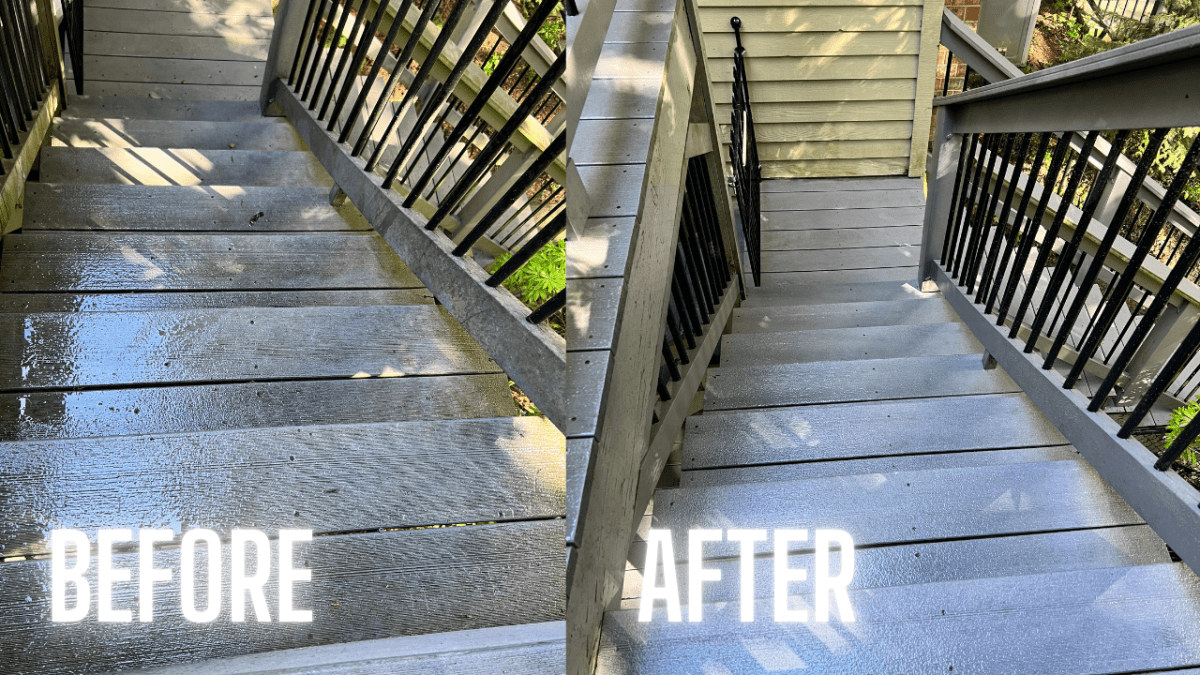
A full deck restoration covers a firmness check of every board, a low-pressure wash of floor, rails and steps, sanding, board repair, and staining once the wood reads dry. GreenTree repairs and restores decks as part of the package. The crew photographs any board that still gives underfoot.
The method matches the surface. Soft washing runs at low pressure, under 500 PSI, so it clears algae and mildew without tearing wood fibre. A pressure washer can reach up to 4400 PSI. That suits concrete but can carve soft earlywood out of a deck. Boards get the gentle side of that scale every time.
On the boards
- The crew tests footing across the whole floor, feeling for any board that gives.
- Wood cleaner goes on next and dwells, so the rinse can stay gentle.
- A low-pressure rinse then runs along each board, keeping the softer earlywood in place.
- Sanding smooths raised grain, and failed boards are repaired or swapped as part of the restoration.
- Rails, balusters and stair treads get detail work with a hand brush, then stain if you book it.
Around the deck
- Plants along the deck edge go under covers, after a thorough soak.
- Furniture and pots leave the deck before the wash and return at the end.
- Photos from before and after the work stay with you, along with notes on any doubtful board.
Stain follows the clean, never runs with it. A dry surface comes first, so staining lands once the moisture reading drops, and that timing is why GreenTree often splits the two stages across a season.
What can a deck brightener do, and what can it not do?
A brightener targets specific stains, such as iron marks and tannin bleed, rather than the grey itself. Wood brightening is an optional add-on to GreenTree’s deck work. The Wood Handbook notes that many cleaners rely on sodium percarbonate, an oxygen bleach, while oxalic acid clears iron and extractive bleed.
Iron stains around fasteners
Blue-black streaks around nail heads form where iron meets tannin in the wood. Cedar and redwood carry plenty of tannin, so plain steel nails tend to mark them. Pine holds little tannin, and its rusty fasteners leave a brown ring instead. Iron travels through wood only while the wood stays damp, so iron stain is mostly an outdoor problem.
Oxalic acid can clear the mark for a while. If even a trace of iron stays behind, sunlight breaks the acid down and the stain returns. A corroding nail head is therefore a fastener question first, since the stain follows the iron, and the crew raises it at the walkthrough.
Cleaners that remove wood
Some cleaners instead use sodium hydroxide, a strong alkali that pulps the wood surface. The handbook reserves those for a last resort. When a pressure washer then strips the pulped layer, the colour looks new only because wood has gone. GreenTree keeps to gentle cleaners and a sanded, stained finish, so the board stays wood rather than losing it.
When does a deck need a rebuild rather than a restoration?
A moving post, a rocking stair or widespread framing rot calls for a builder before any restoration goes ahead. GreenTree repairs and restores deck boards and surfaces. Safety comes first, so the crew flags framing a walkthrough cannot vouch for.
Five signs that call for a builder
- Dark brown wood with cross-grain cracks running through framing.
- A joist or beam that flexes under weight. Surface repair cannot carry a frame that has given way.
- A rocking post, guard or stair. Guards and stairs carry people, so a builder sets them right first.
- Soft wood at the ledger. The ledger ties the deck to the house wall, so a builder checks it before a restoration.
- A deck pulling away from the house. That is a structural call, not a surface one.
Where the Corvallis permit lines sit
The Corvallis permit handout puts building, demolishing or altering a raised deck on its permit list. Replacing a raised exterior stairway needs a permit too. A low deck close to the ground stays exempt.
The city structural permit page adds that its list is not all-inclusive, so ask Development Services about your scope.
Does a deck on a historic Corvallis house need city review before work?
In a Corvallis historic district or on a listed historic house, deck changes can need a Historic Preservation Permit. The city names three National Register districts: Avery-Helm, College Hill West and Oregon State University. Many designated resources sit outside those districts, each listed on its own. A wash leaves the structure as it was.
Routine maintenance appears among the exempt activities on the city Historic Preservation Permits page. An exemption request lets planning staff confirm that, and it also costs nothing. Permit applications, by contrast, carry fees, so the exemption route suits a clean or a like-for-like board repair.
The city historic preservation page counts many designated historic resources, most of them inside those three districts. Ask the Planning Division before any board on a historic house changes shape or profile. A clean touches only the surface, so it keeps the deck as the city has it on record.
How much drying time does a Corvallis deck get after a wash, month by month?
July and August run as the driest months at the Corvallis NOAA station, each averaging only a handful of days with measurable rain. September and June come next. The wet stretch from November into January brings rain on most days. A summer wash gives the boards the longest dry run afterwards.
Monthly dryness from the NOAA climate normals for the station listed as Corvallis State Univ.
| Month | How wet it runs | Good for a wash? |
|---|---|---|
| July | Driest stretch of the year. | Ideal, and the window stain plans around. |
| August | Nearly as dry as July. | Ideal. |
| September | Dry days still common. | Good. |
| June | Drying out fast. | Good. |
| October | Rain returns toward midmonth. | Fair, early in the month. |
| May | Showers easing. | Fair. |
| April | Still showery. | Fair. |
| March | Wet most weeks. | Wait if you can. |
| November | Rain on most days. | Wait. |
| February | Wet and cold. | Wait. |
| January | Wettest and frostiest. | Wait. |
| December | Wet, with hard frosts. | Wait. |
A wash puts water into the boards, and each wet day afterwards puts more back, which is why the stain date tracks the forecast.
Rot, frost and the shoulder months
Spring and autumn in Corvallis stay mild while logging many wet days. A deck that holds water then sits right in the fungi’s comfort zone. Spring and autumn checks therefore matter most for a deck that stays shaded or slow to dry.
Winter brings a second problem. December and January often drop to freezing overnight. Water left on the boards after a cold-weather wash can freeze before it dries. Ice makes a deck slick, so the crew steers washing toward the drier, milder stretch of the year.
Summer flips both risks off. Long, warm, dry days pull moisture out of the wood quickly. That is why the Corvallis deck staining page plans its work for those months. Stain needs dry wood, and summer delivers it.
What happens on a deck restoration visit, from first call to hand-over?
Six fixed steps carry a deck restoration Corvallis booking from your first message to a final walk. A board that needs a builder’s eye ends the walk with a note. Otherwise you approve a written figure, and the crew clears, covers, washes, sands and restores.
Send the deck details.
Use the form or call, and mention the size as well as any soft spots or a stain plan.
Walk the deck together.
On site, the crew tests every board for give and notes soft spots or loose rails. This walk is not a structural inspection, so a builder judges posts, framing and the ledger.
Approve one written figure.
You sign off on the written price before any water touches the deck.
Clear and cover.
The crew covers nearby planting and moves furniture, pots and mats off the boards.
Wash, sand and repair.
Wood cleaner sits briefly, a low-pressure rinse runs along each board, then sanding and board repair follow.
Finish with stain, then walk it again.
The crew lays stain once the wood reads dry, then walks the deck with you and hands over the photos.
Stain waits for dry boards, as the deck staining page for Corvallis explains. Most stains need 24 to 48 hours of dry weather first, and a moisture reading under 15 percent before the first coat.
Who should book a deck restoration, and who should wait?
Book a restoration when the deck stands firm and the surface looks tired: grey, green, dull or lightly worn. The deciding question is structural, because a restoration renews wood but a frame that has failed wants a builder first. Anything that flexes at the joists or rocks waits.
It suits:
- Owners of firm decks gone grey, green or dull after a few wet winters.
- Anyone who wants the colour back, since the package sands and stains as well as cleans.
- Sellers who want the deck clean and restored before listing photos.
- Landlords between tenancies, because before and after photos record the state of the deck.
It does not suit:
- Any deck whose framing has given way, until a builder has made it sound.
- Anyone who wants a brand-new deck, new stairs or new framing, since GreenTree does no new construction.
- A historic house needing a board profile changed, until the Planning Division has answered.
The question splits on structure, not on looks. A dull deck that stands firm is exactly the deck a restoration brings back.
What does the quote check before a deck restoration gets a figure?
Ten checks on the walkthrough set the method and the written figure. Firmness comes first, then any moving stair or known framing rot, since each can stop the job until a builder has worked. The other eight weigh height, wood, coating, size, rails, shade, historic status and access.
- Firmness: the crew tests each board for give before writing any figure.
- Framing and stairs: if a stair moves or you know of framing rot, a builder goes first.
- Height: a raised deck or a raised stairway can become city permit work for a builder.
- Wood species: cedar and redwood hold tannin, so stains around nails get a closer look.
- The old coat: a peeling or solid coat changes the sanding and the stain plan.
- Size: the floor area sets where the job lands inside the range.
- Rails and steps: a long run of balusters adds hand work and lifts the figure.
- Shade: boards under trees dry slowly, which pushes back any stain date.
- Historic status: on a listed house or in a district, any change plan goes to the Planning Division first.
- Tap and access: the hose needs an outdoor tap, and the crew needs a clear path to the deck.
Each check feeds one written number, and that number holds while you decide.
The price list for deck restoration, written before any water runs
These Corvallis bands follow the published GreenTree deck rates, and the walkthrough fixes your figure inside them.
| Job | What it covers | Price |
|---|---|---|
| Deck cleaning and restoration wash | Every board, rail and step, washed gently | $350 to $2,000 |
| Deck staining, with cleaning and sanding | The surface renewed and a fresh coat laid on dry wood | $1,500 to $4,500 |
| Full deck package | Cleaning, sanding, staining, repairs and restoration together | About $3,000 |
| Wood brightening | An optional add-on for iron marks and tannin bleed | $299 to $500+ |
| Fence staining on the same visit | A separate add-on for a wood fence | $299 to $500+ |
| Zinc or moss-out treatment | A targeted add-on line on shaded boards | $299 |
Booking three or more services together saves 10% to 25%, set by how many you book. For house, roof or gutter figures, open the Oregon cost guide.
Every row above becomes one written number before booking. The free visit turns the range into your figure, and the figure holds while you decide. GreenTree provides free on-site quotes with upfront pricing and no hidden fees, so nothing rides along behind the number.
Why Corvallis homeowners choose GreenTree for deck restoration
Three facts a competitor cannot copy, each backed by a record you can check.
How much liability insurance backs a Corvallis deck restoration?
GreenTree carries $2 million in general liability insurance on every deck job, a figure listed on the company insurance certificate. The cover has stood on every job since GreenTree began trading in 2022, and the certificate goes on file for any landlord, lender or HOA.
How do Corvallis customers rate GreenTree deck restoration?
GreenTree holds a 5.0 rating on Google. Each review names a real job across the Willamette Valley, and the crew answers every one in the owner’s voice.
What is GreenTree’s Oregon registration for deck work?
GreenTree Services holds Oregon business registry number 2424331-91. That number is a business registration only, and it has stood since the company began trading in 2022.
GreenTree is open seven days a week, 7am to 7pm, so a walkthrough fits around your week rather than squeezing into a narrow slot. Call 971-280-2861 or send the form, and the deck gets a firmness check and a written figure before any water runs.
Where in Corvallis does GreenTree take on deck restoration?
Deck restoration Corvallis service reaches the whole city, from the Northwest Hills down to South Corvallis. Each visit starts with the same walk-round, whatever the street, and ends with one written figure.
Neighbourhoods on the route: College Hill, Downtown, Northwest Hills, Oak Creek, South Corvallis, Stoneybrook, Timberhill and Witham Hill.
Benton County sits in the heart of the Willamette Valley, so decks here face the same wet winters and dry summers wherever they stand. The crew matches the method to the boards on each job, sands and restores what has worn, then fixes the price in writing before the first rinse.
Other Corvallis services
Related pages
More questions about deck restoration, answered briefly
Quick answers on repairs, composite boards, wet wood, plants, staining and insurance.
Does GreenTree repair decks, or only clean them?
GreenTree repairs and restores decks as part of a full deck package. The package covers the whole job, from cleaning and sanding to staining, board repair and restoration, and typically costs about $3,000. The crew sets every figure in a free written quote before any work starts.
Do composite deck boards get the same wash as wood?
Not quite. Grime and green film still build up in composite texture. Its pressure limit comes from the maker, so the crew checks the care guide for your brand before washing. If the boards carry a warranty, say so when you book the walkthrough.
Why do washed boards look darker until they dry?
A fresh wash leaves water in the fibre, and wet wood shows a deeper, richer tone than dry wood. The Wood Handbook calls this an optical effect, since the eye sees further into wet wood. Wait until the boards dry before you compare them with the before photos.
Will the deck wash harm plants beside the boards?
The crew soaks the beds first and covers them, so cleaner has less chance to settle on leaves. Covers stay over any bed that touches the boards until the washing is over.
How long before GreenTree can stain after a deck wash in Corvallis?
Stain waits for dry wood, not wet. Most stains need 24 to 48 hours of dry weather after the wash, and a moisture reading under 15 percent before the first coat. Stain over damp wood traps moisture and fails early, sometimes within one season, so a dry summer week is the safe window.
What does a full deck restoration cost in Corvallis?
Deck cleaning runs $350 to $2,000. Deck staining, including cleaning and sanding, runs $1,500 to $4,500. A full deck package covering cleaning, sanding, staining, repairs and restoration typically costs about $3,000. Each price is fixed in a free written quote before work starts.
Does GreenTree carry insurance for deck work?
Yes. GreenTree carries $2 million in general liability insurance, verifiable on the company insurance certificate. Request the certificate with your quote if a landlord, lender or HOA needs it on file.
Book a deck restoration walkthrough in Corvallis
Send the form or call, and the crew checks the deck for firmness and writes a figure before any water runs.
Sources: Monthly climate normals, NOAA Corvallis station; Do I Need a Permit, a City of Corvallis guide; Structural building permit page, Corvallis Development Services; Historic preservation overview, Corvallis Community Development; Historic Preservation Permits and exemption requests; OSU Extension wood manual; USDA Forest Products Laboratory, Finishing Wood; Oregon business registry search.