
How Often Should You Clean Your Gutters in Eugene? It Depends on Your Trees
Updated 20 October 2026
Most homes in Eugene and Springfield need their gutters cleaned at least once a year, in late October or November after the leaves are down. Homes under Douglas-fir, cedar or pine usually need a second cleaning in spring, and lots with heavy mixed tree cover can need three. The right schedule depends less on the house than on the trees around it.
The short answer
How often should gutters be cleaned in Eugene? At least once a year, after leaf drop in late October or November. Twice a year if fir, cedar or pine overhang the roof, which is common in the South Hills and other wooded neighborhoods.
When is the best time? Right after the last big leaf fall and before December. Cleaning too early, in September, leaves the gutters full again by the first heavy storms.
What happens if you skip it? Clogged gutters overflow and dump roof water along the foundation, down the siding and across walkways, right where a house is built to keep water out.
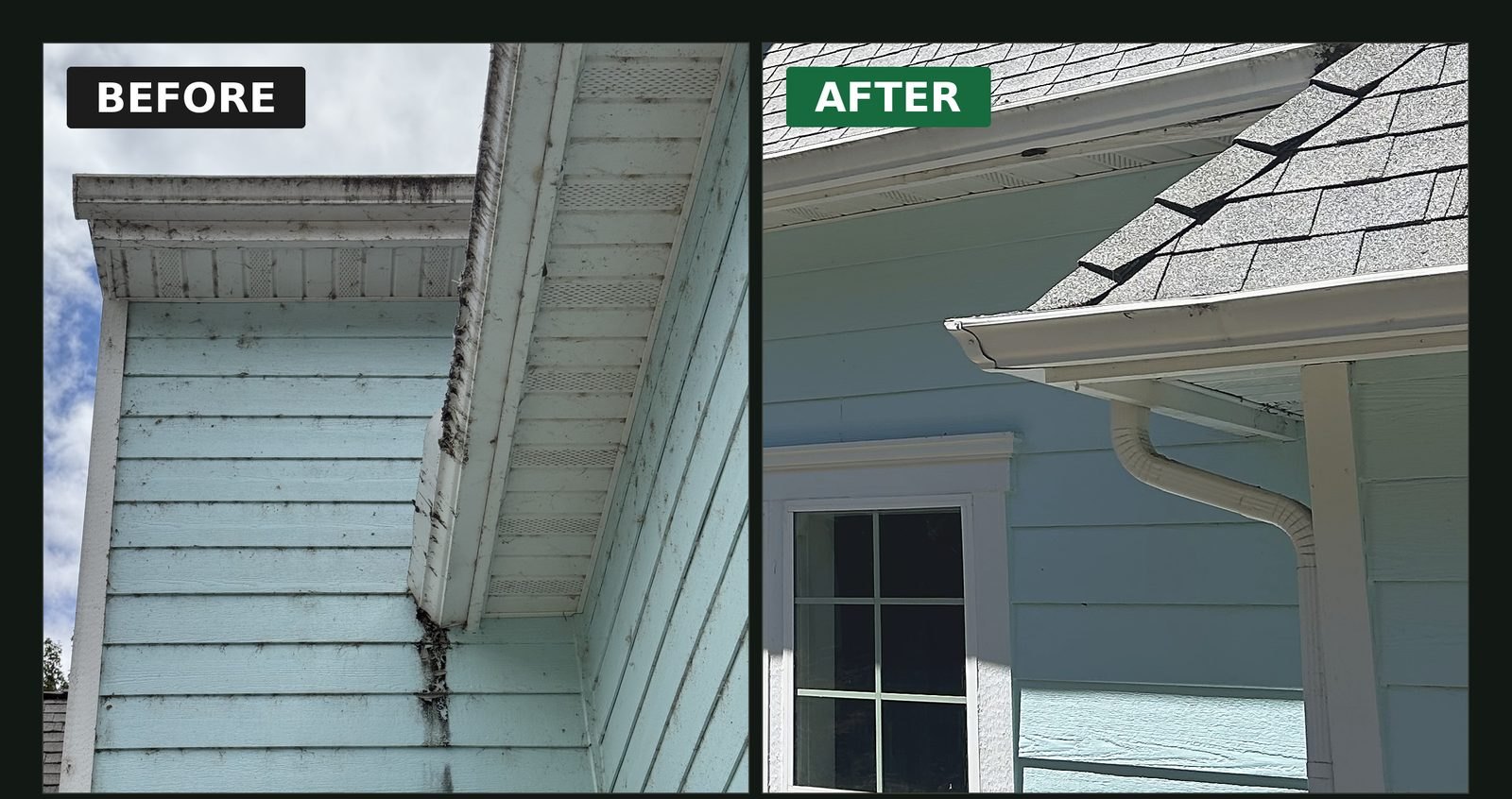
Gutter cleaning schedule for Eugene and Springfield homes
Use the trees over or near your roof to set the schedule. A ranch house in River Road with a young street tree needs far less attention than a South Hills home under a stand of Douglas-fir.
| Trees over or near the roof | Suggested cleaning schedule | Why |
|---|---|---|
| None or only small ornamental trees | Once a year, in late fall | Roof grit and windblown leaves still collect |
| Oak, maple or other leafy trees | Once a year, after leaf drop in November | Most debris arrives in a few weeks |
| Douglas-fir, cedar or pine | Twice a year: late fall and again in spring | Needles and cones fall through much of the year |
| Heavy cover of mixed trees | Two or three times a year | Leaves in fall, needles and cones in spring and summer |
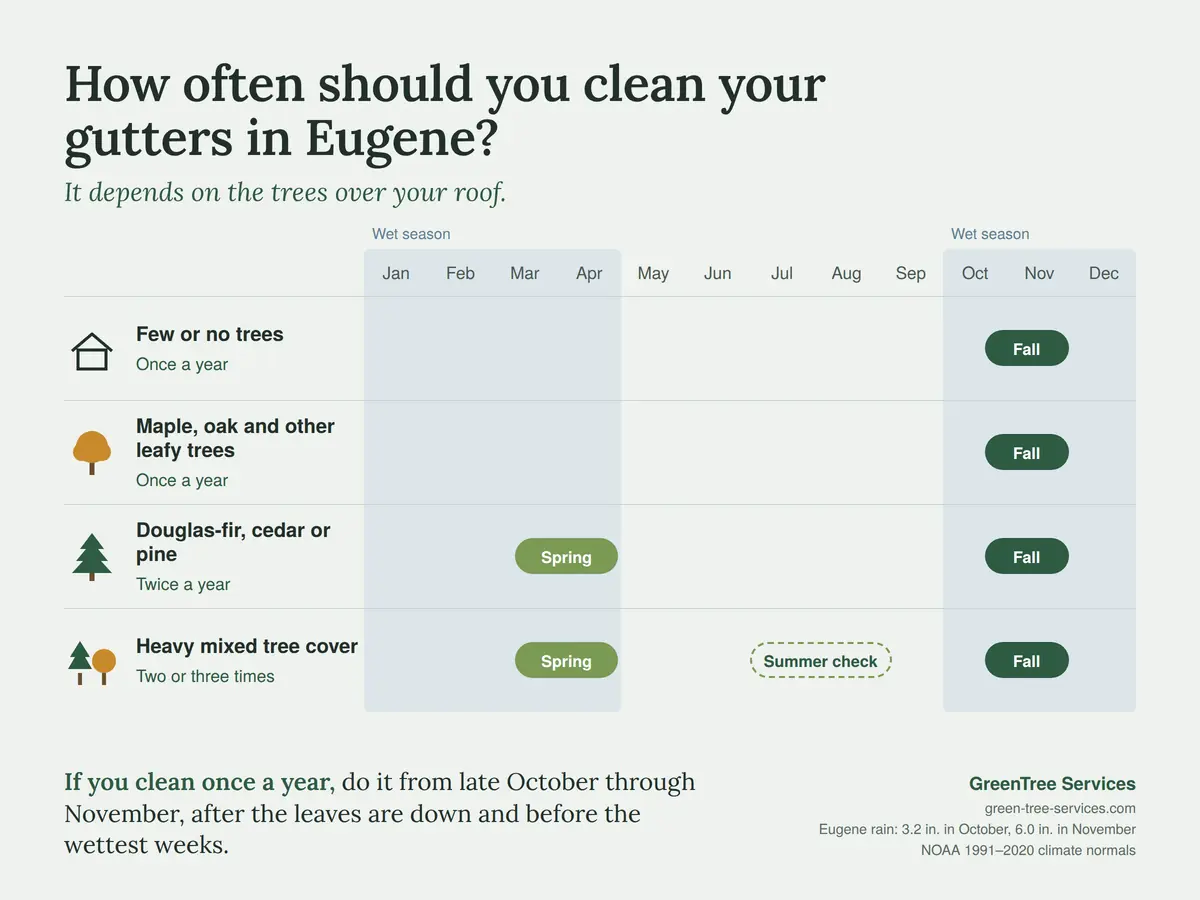
If you can only schedule one cleaning a year, make it the late-fall one. It is the cleaning that keeps gutters running through the wettest months, when a clog does the most damage.
Gutter guards can stretch the time between cleanings, but they are not a cure. InterNACHI notes that covered gutter systems are not maintenance-free. Fir needles in particular slip through or pile up on top of many guard designs.
What causes gutters to overflow?
A clog causes most overflow, but not all of it. Where the water spills over is your best clue to which problem you have.
| Cause | What you will see in the rain | Cleaning fixes it? |
|---|---|---|
| Clogged trough | Water spills over the front edge along a long stretch, often under trees | Yes |
| Plugged downspout | Gutter fills and overflows near the downspout, and little or no water comes out the bottom | Yes, by flushing the downspout |
| Packed downspout elbow | Same as above, often with a gurgle or bulge at the bend | Usually; an elbow sometimes has to come apart |
| Plants or moss growing in the gutter | Green tufts along the top edge; slow, steady overflow | Yes |
| Wrong slope | Water sits in one section after the rain stops and spills at the low spot | No; the gutter needs re-pitching |
| Gutter or downspout too small | Overflow only in heavy downpours, even when clean | No; it needs a bigger gutter or more downspouts |
| Loose or bent hangers | A sagging section where water pools and spills | No; hangers need repair |
| Water shooting past the gutter | Water drops behind or over the gutter at valleys and steep roof sections | No; it needs a gutter guard, splash diverter or flashing work |
The InterNACHI home inspection guide says gutters should slope toward the downspout at about 1/4 inch per 5 to 10 feet. A simple check: after a rain, any section still holding standing water away from the downspout is likely sloped wrong.
Why do Eugene gutters clog so fast?
Eugene gutters clog because the heaviest leaf fall and the start of the rainy season arrive together. The NOAA climate normals for 1991 to 2020, as compiled by Current Results, put the Eugene average October rainfall at 3.2 inches. November nearly doubles that at 6.0 inches. Over a full year the city averages 40.8 inches on 146 days with measurable precipitation, most of it between October and spring.
The trees in and around Eugene load gutters on different schedules:
- Bigleaf maple, oak and other leafy trees drop most of their leaves in fall. Big maple leaves mat together when wet and seal the downspout opening.
- Douglas-fir, cedar and pine shed needles, cones and twigs through much of the year. Needles slip past many gutter guards and pack tightly in downspout elbows.
- Roof grit and moss wash off older shingle roofs and settle in the trough like sand.
Many Eugene lots have both kinds of trees, especially in the South Hills, the Friendly Area and along the edges of town toward Spencer Butte. Leaves and needles arrive at different times, so a single fall cleaning often is not enough there.
What happens if gutters keep overflowing?
Overflowing gutters put roof water exactly where a house is built to keep it out. InterNACHI notes that a few inches of rain on a roof can produce several thousand gallons of runoff, and that water left near the foundation can saturate the soil and wick inside, leading to mold and wood rot. That is why it recommends downspouts that carry water 4 to 6 feet away from the foundation.
The most common damage from repeated overflow:
- Wet crawlspaces and basements. Water dropping straight down beside the foundation soaks the soil against it all winter.
- Rotting fascia and soffits. Water spilling over the back of the gutter runs onto the fascia board the gutter is fastened to.
- Stained and streaked siding. Overflow runs down the same stretch of wall every storm, leaving dirt lines and green growth.
- Eroded beds and splashback. A steady curtain of water digs a trench in the soil and splashes mud onto the lower siding.
- Slippery steps and walkways. Paths under an overflowing gutter stay wet and grow moss and algae, which the Oregon State University Solve Pest Problems guide calls a slipping hazard.
- Gutters pulling loose. A gutter full of wet debris and water is heavy, and the extra weight works hangers out of the fascia over time.
Should you clean your gutters yourself?
A single-story house with gutters you can reach from a stable ladder on level ground is a reasonable do-it-yourself job. Two-story gutters, steep lots and wet fall weather are where it gets risky. A study by the Center for Injury Research and Policy in Columbus, Ohio, found that U.S. emergency rooms treated an average of about 135,000 ladder injuries a year from 1990 to 2005, and the yearly count rose about 50 percent over that period.
If you do it yourself
The InterNACHI homeowner tips cover the basics:
- Set the ladder on firm, level ground, and have a spotter if you can.
- Keep three points of contact on the ladder. Move the ladder rather than reaching sideways.
- Wear gloves. Gutter debris can hide sharp metal, screws and insects.
- Scoop the debris out by hand or with a gutter scoop, working toward the downspout.
- Flush each downspout with a garden hose and watch that water runs freely out the bottom.
- Check that the water leaves the downspout and flows away from the house.
Skip it on a wet or windy day, and stay off the roof. Wet shingles, moss and fir needles make a roof surface slick.
When to hire it out
Hire a crew for gutters on a second story, over a slope, above a deck or skylight, or along a steep roof. The same goes if you are not comfortable on a ladder. A good gutter cleaning should include clearing the troughs by hand, flushing and flow-testing every downspout, and bagging the debris rather than leaving it in your beds. The GreenTree gutter cleaning service works from ladders and reach poles, never by walking the roof, and every job ends with before-and-after photos.
When is overflow a repair problem, not a cleaning problem?
If a gutter overflows right after it has been cleaned and flushed, the gutter itself needs work. Watch for these signs:
- Standing water after the rain stops. The gutter is sloped wrong or sagging between hangers.
- Gaps between the gutter and the fascia. Hangers have pulled loose, or the fascia behind them is soft.
- Drips from seams, corners or end caps. Sealant has failed or a joint has separated.
- Overflow only in heavy downpours. The gutter or downspout may be too small for the roof area draining into it. InterNACHI notes that in areas with high winds and heavy rains, gutter and downspout capacity should be increased, especially on large roofs.
- Water spilling at a roof valley. Fast water off two roof planes can jump the gutter, which may call for a splash guard or diverter.
Gutter repair, re-pitching and replacement are construction work. The Oregon Construction Contractors Board requires a CCB license for most construction and repair services, and you can check any contractor in the CCB license search. GreenTree cleans gutters but does not repair or install them. When a crew spots loose hangers, failed seams or soft fascia during a cleaning, you get a photo and a note so a licensed gutter contractor can take a look.
Frequently asked questions
Why do my gutters overflow even when they are clean? A clean gutter that still overflows usually has a slope problem, a sagging section, or not enough downspout capacity for the roof above it. Those are repair issues for a licensed gutter contractor.
How do I know if my downspout is clogged? During a steady rain, the gutter fills and spills near the downspout while little or no water comes out the bottom. You may also hear gurgling or see the downspout bulge at an elbow.
How much does gutter cleaning cost in Eugene? Gutter cleaning starts at $299, the GreenTree minimum, on one storey or two. The final price depends on the size and height of the home, access, and how packed the gutters are, and you get a written quote before any work begins.
Do gutter guards stop gutters from overflowing? They reduce how often gutters clog, but they do not eliminate cleaning. Fir needles and roof grit can still build up on or under many guards, and guards themselves need periodic clearing.
Can overflowing gutters damage my foundation? They can. Repeated overflow soaks the soil beside the foundation, and InterNACHI notes that this water can wick inside and lead to mold and wood rot. Downspouts should carry water 4 to 6 feet away from the house.
Is it safe to clean gutters from a ladder in the rain? No. Wet rungs, wet shingles and soft ground all raise the risk of a fall. Wait for a dry day, or hire a crew for second-story gutters.
Book a gutter cleaning in Eugene or Springfield
Gutter cleaning starts at $299, the GreenTree minimum, on one storey or two. Call (971) 280-2861 or request a free quote online.
The Oregon Construction Contractors Board lists gutter cleaning as work that does not require a contractor license. GreenTree is registered with the Oregon Secretary of State (Registry #2424331-91) and carries $2 million in general liability coverage plus workers compensation. A certificate of insurance is available on request.
Related GreenTree pages: gutter cleaning in Eugene · gutter cleaning in Springfield · gutter cleaning service · pressure washing in Eugene · roof cleaning in Eugene · pressure washing cost guide
About the author
Jeannie D, GreenTree Services
Jeannie D brings 30 years of experience in the legal, title and construction industries to every piece she writes. Those are fields where a single wrong date, name or figure can derail a transaction, and that habit of verifying every detail shapes how she approaches content today. Jeannie studied economics at the University of Arizona and Portland State University. Outside of work, she spends her free time with her family, cooking and reading.
Sources
- InterNACHI: Inspecting Gutters and Downspouts
- Current Results: Average Precipitation for Oregon in October (NOAA NCEI 1991 to 2020 normals)
- Current Results: Average Precipitation for Oregon in November (NOAA NCEI 1991 to 2020 normals)
- Current Results: Average Annual Precipitation for Oregon (NOAA NCEI 1991 to 2020 normals)
- Oregon State University, Solve Pest Problems: Moss on Roofs & Walkways
- Newswise: Nonfatal Ladder Injuries Climbing Sharply (Center for Injury Research and Policy study)
- Oregon Construction Contractors Board: CCB License
- Oregon CCB License Search
Legal disclaimer
This article is for general information only and is not legal, insurance, engineering or professional advice. Licensing rules, building codes and agency guidance change, and how they apply depends on your property and location. Before relying on any of this information, confirm current requirements with the Oregon Construction Contractors Board, your city, your insurance agent, or a licensed Oregon attorney. Ladder work carries a real risk of serious injury; follow the instructions from the ladder manufacturer and hire a professional if you have any doubt. Reading this article does not create any professional or contractual relationship with GreenTree Services or the author, and GreenTree Services makes no warranty about the completeness or accuracy of third-party sources linked here.