
Driveway and Concrete Cleaning in Albany, Oregon
In Monteith and Hackleman the sidewalk is frequently older than the house. Concrete poured before modern mix design is softer and more porous, so it takes less pressure and holds algae deeper. We identify which one you have before anything gets switched on. Driveway cleaning Albany homeowners book starts at $150 to $250 for two cars, with full hardscape at $300 to $500 and no trip fee.
Last reviewed 13 September 2026 by GreenTree Services, Corvallis. At every update we confirm the prices and methods here still match current field practice.
On this page
- Driveway pressure washing Albany OR: age, pressure and harvest film
- Why does old Albany concrete need lower pressure?
- Is Albany concrete less mossy than Corvallis?
- Do you do sidewalk pressure washing in Albany?
- How much does driveway cleaning cost in Albany?
- Concrete cleaning Albany: what each slab will take
- The five steps on every Albany slab
- What actually breaks a historic Albany walkway?
- How does a cleaning job damage concrete?
- Patio cleaning Albany: what it costs and when to book
- When should an Albany driveway be cleaned?
- Albany districts and nearby towns
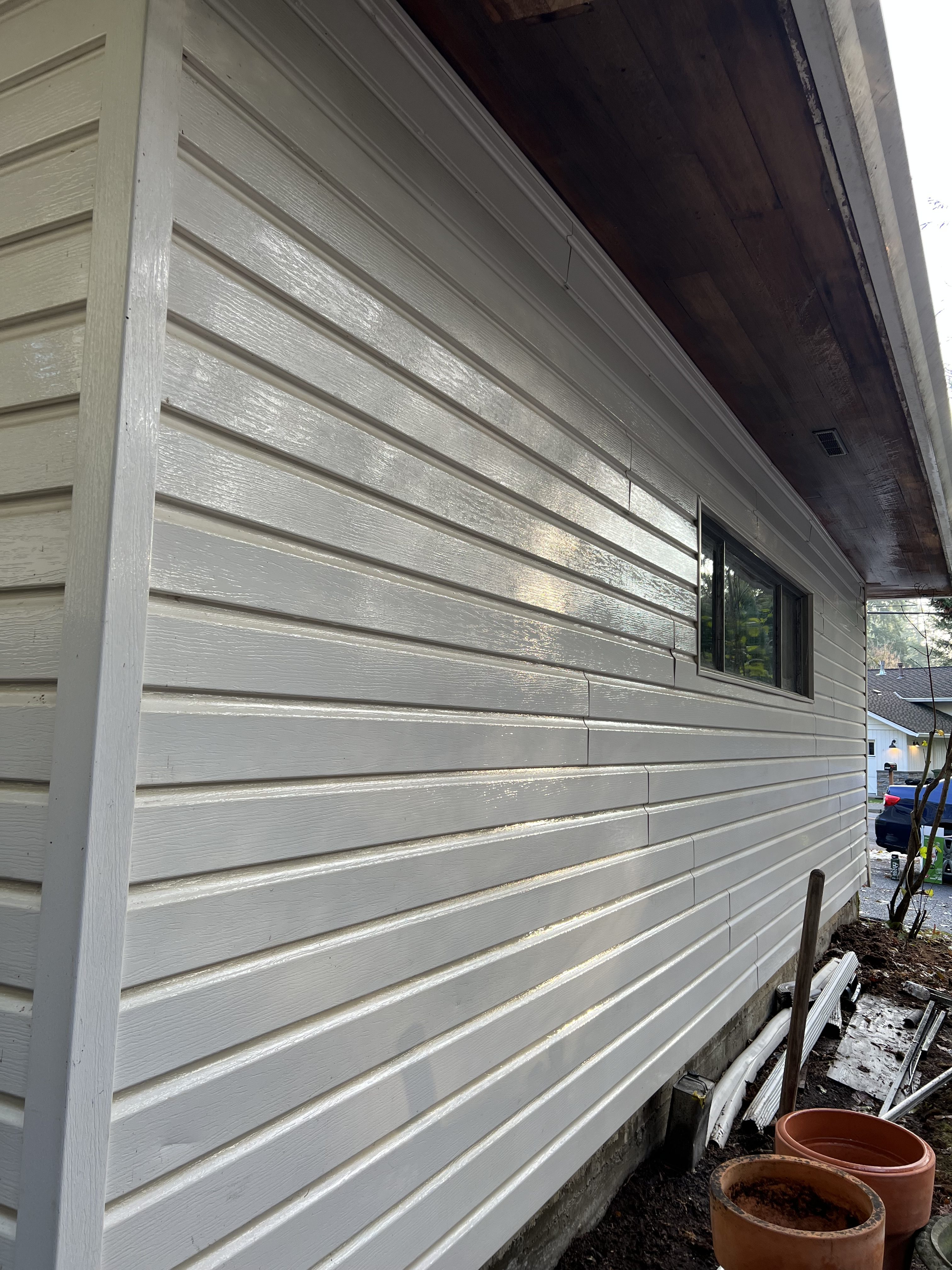
Driveway pressure washing Albany OR: age, pressure and harvest film
Four questions. The first explains why a crew that cleans Corvallis well can still damage an Albany walkway.
Why does old Albany concrete need lower pressure?
Because concrete poured before modern mix design is softer and more porous than a contemporary slab. Monteith and Hackleman carry original scored walkways and drives from the 1900s and 1910s. That surface erodes under a pressure a modern driveway shrugs off. Furthermore it holds algae deeper in the pores. The answer is therefore more dwell time and less force, which is the opposite of what most crews reach for.
Is Albany concrete less mossy than Corvallis?
On open lots, yes. Albany is flatter and carries far less tree canopy, so a driveway here gets more sun and dries faster between rains. Meanwhile the trade-off is harvest dust settling on that same concrete through July and August. Consequently the film that binds once the first rains arrive is the Albany problem. Shade and damp ground are the Corvallis one.
Do you do sidewalk pressure washing in Albany?
Yes, and in the historic districts the sidewalk is often older than the house. Original scored walkways take lower pressure and careful edge work, particularly where a panel has begun to spall. Sidewalk pressure washing Albany OR properties need on open lots cleans at the same pressure as the driveway, so we do both in one visit.
How much does driveway cleaning cost in Albany?
A two-car driveway runs $150 to $250. Walkways and a patio take it to $200 to $350. A full hardscape package covering every hard surface runs $300 to $500. Albany sits fifteen minutes from base, so there is no trip fee and the rates match Corvallis exactly. Full breakdown in the Oregon cost guide.
Concrete cleaning Albany: what each slab will take
In this town the deciding factor is when the concrete was poured, not where the property sits.
| Slab | Where it is common | Pressure and approach |
|---|---|---|
| Original scored walkway, 1900s to 1910s | Monteith, Hackleman | Reduced pressure, long dwell. Porous, and often spalling at the panel edges. |
| Interwar drive and apron | Older central Albany | Lower than modern. Check for aggregate already exposed. |
| Mid-century poured drive | East and South Albany | Handles full pressure. Watch the expansion joints. |
| Modern driveway | North Albany, newer builds | 2,500 to 4,000 PSI with a rotating surface cleaner. |
| Stamped or decorative | Newer builds throughout | Reduced pressure to protect the sealer and the colour under it. |
| Pavers and flagstone | Patios across the city | Lower end only. Joint sand blows out above that. |
| Spalling or aggregate-exposed | Anywhere, any age | Lowest pressure. Pressure accelerates failure already underway. |
| Rural apron and transition | Tangent, Millersburg | Gravel wash onto concrete needs clearing before treatment. |
Method detail by surface type sits on the Oregon driveway and concrete hub. This page covers what changes once the slab is a hundred years old.
The five steps on every Albany slab
Step one is specific to this town, and skipping it is how a walkway gets damaged.
Date the concrete
Age, mix condition and any spalling assessed first, because a 1910s walkway and a modern drive take different pressures.
Protect and plan the rinse
Planting soaked and covered, with run-off routed onto landscaping rather than toward the Willamette and Calapooia drainage.
Pre-treat and let it dwell
Biodegradable treatment applied and given time to lift harvest film and algae, with longer dwell on porous older concrete.
Clean at the pressure that slab takes
Modern concrete at 2,500 to 4,000 PSI with a surface cleaner. Historic and spalling concrete considerably lower.
Hand finish and walk it
Edges, steps, thresholds and scored joints done by hand, then the finished work is walked or photographed.
What actually breaks a historic Albany walkway?
Not the machine. The assumption that every slab in town is the same material.
How does a cleaning job damage concrete?
By running one pressure setting across a property where the slabs are eighty years apart. A modern driveway takes 4,000 PSI without complaint. Take that same setting onto a 1910s scored walkway and it lifts the surface paste, exposes aggregate and accelerates spalling already underway. Consequently the damage reads as weathering rather than as the clean. It surfaces a year later, when nobody connects the two.
| Our standard | What commonly happens instead |
|---|---|
| Every slab dated before a setting is chosen | One pressure across the whole property regardless of age. |
| Longer dwell on porous historic concrete | More force instead, which lifts surface paste. |
| Rotating surface cleaner across open drives | Wand only, leaving bands that read in low winter sun. |
| Scored joints and panel edges by hand | Machine everywhere, chipping the edge of every panel. |
| Spalling flagged in writing before work starts | Discovered afterwards, and blamed on the concrete. |
| Rinse sent onto beds and lawn | Down the gutter to the Calapooia, which DEQ regulates. |
| $2M cover, certificate before we arrive | No insurance, on a surface that cannot be replaced in kind. |
Nobody can replace a hundred-year-old scored walkway to match. That is the whole argument for spending a few minutes identifying it before the trigger gets pulled.
Patio cleaning Albany: what it costs and when to book
| Work | Price | What moves it |
|---|---|---|
| Two-car driveway | $150 to $250 | Soiling, slab age, how much edge and step work is needed. |
| Driveway plus walkways | $200 to $350 | Total area, and whether the walkway is original. |
| Full hardscape package | $300 to $500 | Every hard surface on the property in one visit. |
| Historic scored walkway | Quoted on site | Condition survey first. Reduced pressure, longer dwell. |
| Patio only | Quoted on site | Furniture marks and grill grease both need pre-treatment. |
| Pavers or flagstone | Lower pressure, quoted on site | Re-sanded where the original joint has washed out. |
| Booked with gutters or a roof | Combined discount | One setup, one trip, one water connection. |
When should an Albany driveway be cleaned?
Late August or September, straight after grass seed harvest. That is earlier than the standard advice and it is specific to this town. Clearing harvest dust off concrete before the first rains bind it into a film beats lifting the film afterwards. Spring is the second window, and it clears whatever came through the winter.
Albany districts and nearby towns
Coverage and ZIP codes: both Albany ZIPs, 97321 and 97322. That takes in the Monteith and Hackleman historic districts, the downtown blocks, North Albany over the river, and the East and South Albany neighbourhoods. Tangent and Millersburg run off the same route at the same rates.
Concrete and flatwork nearby
Other Albany services
What Oregon customers say
5.0 across 13 reviews. Read them all →
★★★★★
My driveway and back patio had not been cleaned in years. Both were so bad they looked black. By the time Green Tree was done both looked almost brand new.Diane M.
★★★★★
I highly recommend this company for their professionalism in the excellent quality of their work, attention to detail, customer service, dependability, conscientiousness, and personal integrity.Pam G.
★★★★★
GreenTree Services did a great job for us! Quick, efficient, and friendly. Give them an opportunity to show you what they can do for you!Michael S.
Frequently asked questions
Ten Albany questions, each mirrored in the FAQ schema on this page.
How much does driveway cleaning cost in Albany?
A two-car driveway runs $150 to $250, walkways and a patio take it to $200 to $350, and a full hardscape package covering every hard surface runs $300 to $500. Albany sits fifteen minutes from base, so there is no trip fee and the rates match Corvallis exactly.
Why does old Albany concrete need lower pressure?
Because concrete poured before modern mix design is softer and more porous than a contemporary slab. Monteith and Hackleman carry original scored walkways and drives from the 1900s and 1910s, and that surface erodes under pressure a modern driveway shrugs off. It also holds algae deeper in the pores, so it needs more dwell time and less force rather than the reverse.
Is Albany concrete less mossy than Corvallis?
On open lots, yes. Albany is flatter and carries far less tree canopy than Corvallis, so a driveway here gets more direct sun and dries faster between rains. The trade-off is harvest dust settling on that same concrete through July and August, which gives algae something to bind to once the first rains arrive.
Do you do sidewalk pressure washing in Albany?
Yes, and in the historic districts the sidewalk is often older than the house. Original scored walkways take lower pressure and careful edge work, particularly where a panel has started to spall. On open lots and newer streets the walkway cleans at the same pressure as the driveway, so both are usually done in one visit.
Why do some driveways come back with stripes?
Because the crew used a wand instead of a rotating surface cleaner. A wand throws a narrow arc, so overlapping passes leave bands across the slab that read clearly in low winter sun. A surface cleaner holds a fixed circle at constant height, which is why its finish is even. Once a slab is banded the only fix is cleaning the whole thing properly.
Can you remove oil stains from an Albany driveway?
Usually, though age decides how much. Fresh oil lifts with a degreaser and hot detergent. Oil that has sat for years has penetrated the concrete rather than resting on it, and older porous concrete absorbs more of it. You get told which of those two to expect while we are still quoting.
When should an Albany driveway be cleaned?
Late August or September, straight after grass seed harvest. That is earlier than the standard advice and it is specific to this town, because clearing harvest dust off concrete before the first rains bind it into a film is easier than lifting the film afterwards. Spring is the second window.
Which Albany areas do you cover?
Both Albany ZIPs, 97321 and 97322, taking in the Monteith and Hackleman historic districts, the downtown blocks, North Albany over the river and the East and South Albany neighbourhoods. Tangent and Millersburg run off the same route at the same rates.
Will pressure washing damage my concrete?
Not at the correct pressure for that particular slab. Sound modern concrete handles 2,500 to 4,000 PSI from a rotating surface cleaner without issue. Century-old or already spalling concrete does not, and it gets reduced pressure with a longer dwell instead. Identifying which one you have is the first thing we do.
Is GreenTree insured?
Yes. GreenTree Services carries $2 million in general liability insurance, and the certificate is available before the crew arrives. The company has been registered with the Oregon Secretary of State since 2022 under Registry number 2424331-91.
Get your Albany concrete quoted
Slab dated first, written figure, locked price, no trip fee. Late August through September is the window that matters here, straight after harvest.
GreenTree Services, 1460 NW Van Buren Ave, Corvallis, OR 97330 · (971) 280-2861 · Oregon Registry #2424331-91
Sources and standards: OSHA ladder safety · Oregon DEQ stormwater rules · NOAA rainfall data · OSU Extension · Verify Registry #2424331-91