
Gutter Cleaning in Albany, Oregon
Gutter cleaning in Albany, Oregon means clearing leaves and sludge by hand, then flushing each downspout. Before any of that, we ask whether the gutter hangs off the fascia or sits built into the roof. Clearing starts at $299 for a single-story home, the same price Corvallis customers pay. Albany carries no trip fee because it sits fifteen minutes from our base. Our crew clears built-in box gutters by hand on Monteith and Hackleman houses. After harvest, we dig out the gray dust layer under the leaves rather than skimming the top.
Updated 28 October 2026. Current Albany gutter prices and methods on the Linn and Benton route, matching what the crew does on both banks of the Willamette.
On this page
- Before you book, what should you know?
- How much does gutter cleaning cost in Albany, Oregon?
- Inside the service: what you get
- Gray sludge after harvest, explained
- Do you repair gutters in Albany?
- What can you verify before booking?
- Why the work follows the rivers, oaks and harvest
- How does a visit run, step by step?
- Why do two Albany quotes differ?
- Who should book, and who needs an installer?
- What the quote checks
- Albany gutter cleaning price bands
- Which month suits the job best?
- Districts and nearby towns
- Albany gutter cleaning FAQ
What should you know before booking gutter cleaning in Albany, Oregon?
Every answer below rests on a price we quote or a condition this town produces, not on borrowed copy.
How much does gutter cleaning cost in Albany, Oregon?
Gutter cleaning in Albany, Oregon starts at $299 for a standard single-story home, the GreenTree minimum on one story or two. Corvallis customers pay exactly the same figure, and Albany adds no trip fee. Run length, downspout count and sludge depth set the price within the $299 to $1,000+ range. We walk the property first, and then the number goes in writing. It holds from quote to invoice, so the day never ends with a surprise line. You see the full figure before anyone climbs a ladder.
What does gutter cleaning in Albany, Oregon include?
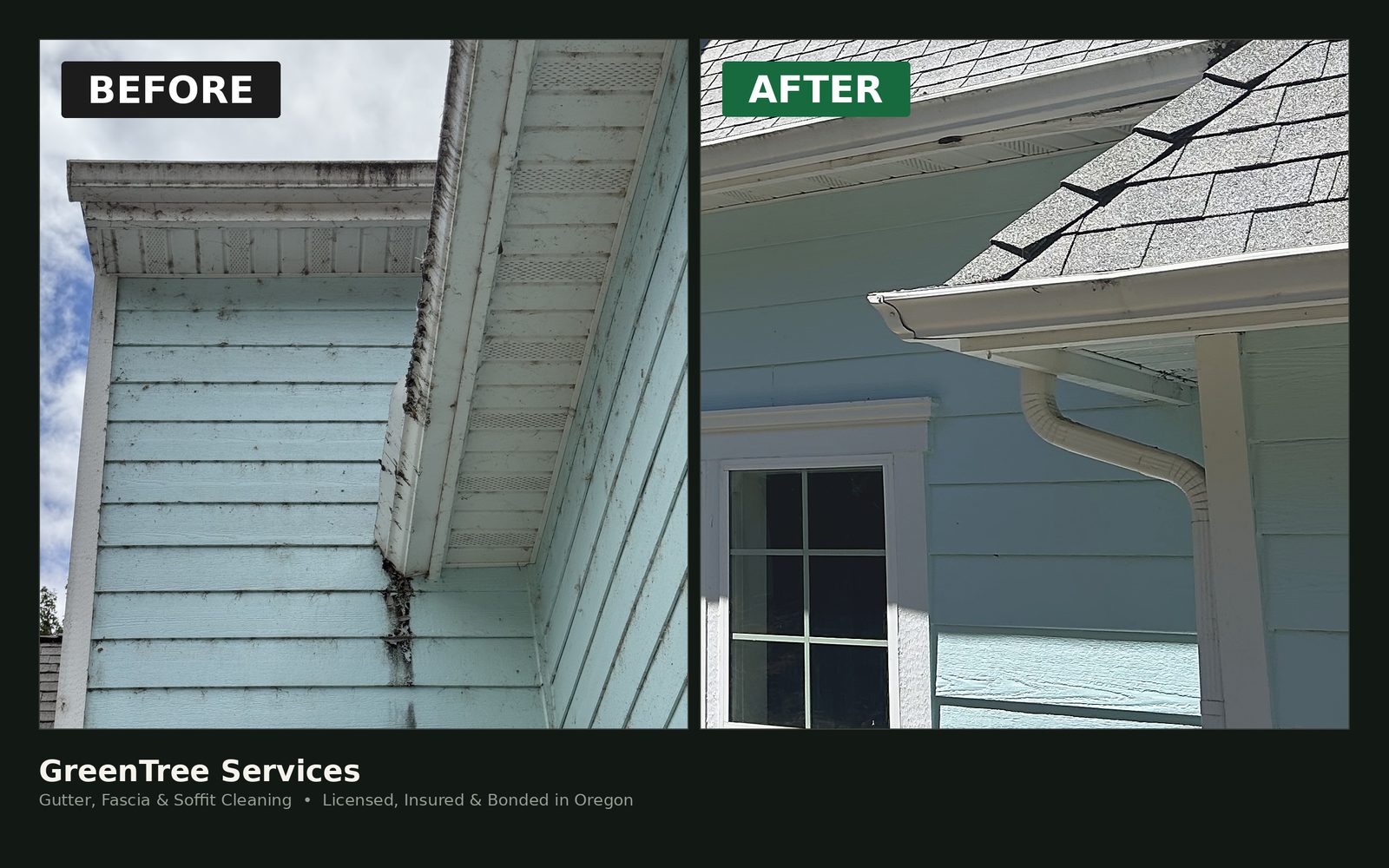
A full clean means six tasks, from the roof edge down to the ground. Our crew empties every trough into bags by hand, then sends water down each downspout. A hose test follows along the whole system. Finally, a cloth clears the streaks off the face, and photos finish the visit.
In full, the Albany gutter cleaning list reads as six lines:
- Scooping each trough by hand, right down to the harvest dust at the bottom
- Bagging the debris and carrying it off your property
- Sending water down each downspout and watching where it comes out
- Running a hose along each run to check the seams and outlets
- Wiping the gutter face and the fascia board behind it
- Photos before and after, with any seam or hanger fault noted
Guards, repairs and new runs sit outside that list, because those belong to a gutter installer, not a cleaning crew.
What is the gray sludge in Albany gutters after harvest?
Harvest sludge is field dust from the grass seed harvest, turned to paste by autumn rain. Linn County carries the title Grass Seed Capital of the World. Harvest fills the dry months with airborne dust, so it drifts into every open trough.
Rain then wets it. The dust settles under the leaves as a heavy gray layer until it plugs the outlet.
A crew that lifts only the leaves leaves that plug behind, so the gutter spills at the first real storm. Water often runs straight down the fascia and into the wall behind it.
Do you repair gutters in Albany?
No, gutter cleaning in Albany, Oregon stops at cleaning, while a gutter installer handles repairs, guards and new runs. We look for split seams, loose hangers and soft fascia as the crew works along each run. Anything we find goes into your photo report with a plain note.
You can then hand those photos to your installer, so they can quote without a second visit.
What can you verify about GreenTree before booking Albany gutter cleaning?
Three facts on this job carry a figure and a public source, so you can check each one before a ladder goes up.
How is GreenTree’s insurance verified for Albany gutter work?
$2 million in general liability insurance, with workers compensation alongside it, stands behind every GreenTree ladder job in Albany, a figure carried on the company’s certificate of insurance. We can provide that certificate on request or for commercial review, so owners and property managers can read the cover.
What proves GreenTree is a registered Albany-area business?
Oregon Secretary of State registry number 2424331-91 identifies GreenTree Services as a registered Oregon business, a business registration on file with the state and open to public lookup. Anyone can confirm it in the Secretary of State business search, but it is a registration, not a contractor license.
How long has GreenTree cleaned gutters near Albany?
Founded in 2022, GreenTree Services has cleaned Willamette Valley gutters for four seasons, a start date recorded on the Oregon business registry. That record sits beside a 5.0 Google rating, earned on exterior work in Albany, Corvallis and the valley between them.
Why does gutter cleaning in Albany, Oregon follow the rivers, the oaks and the harvest?
What lands in an Albany trough comes down to four local conditions, and each one shapes how the crew gets it back out. Box gutters in Monteith and Hackleman need hand work, oak and maple shed on the river flats, fir needles fall in North Albany, and rain rarely lets up from autumn to late spring.
Why do Monteith and Hackleman box gutters need hand work?
Albany’s two residential historic districts, Monteith and Hackleman, sit a few blocks apart downtown. Both appear on the National Register of Historic Places. Hackleman alone holds hundreds of historic properties across its grid of downtown blocks. Many older houses there carry box gutters, which run inside the roof edge instead of hanging off a fascia board.
A metal liner usually forms the channel. Any blockage then backs water up into the roof structure rather than spilling off the edge. We clear these by hand for that reason, and keep pressure well away from a liner seam. Each seam also gets a look before anyone climbs down. Catching a hidden split up there early costs far less than chasing a leak after it stains the plaster.
Oak and maple on the river flats
Albany grew up where the Calapooia meets the Willamette, on one of the broadest, flattest stretches of the valley floor. Oregon State University’s forestry notes describe Oregon white oak as well suited to this riverside ground. It shrugs off both wet winters and dry summers. Bigleaf maple, another native, drops its broad leaves across the same autumn weeks. Both shed just as the rain returns, so the leaves land wet and mat flat over an outlet. Wet mats never dry, so they never blow clear. Raking the yard does nothing for the trough above it.
Fir needles on the North Albany side
Across the Willamette from downtown, North Albany falls in Benton County rather than Linn. Douglas fir stands over many a roof there. Its needles slip past the leaves to the trough floor. Mixed with harvest dust, they form a wet felt. Only a scoop will lift it, since a rake or a blower just pushes it around. A North Albany lot under fir usually earns the November visit too, once the broadleaf trees have finished dropping.
Rain through much of the year
Rain returns to the valley in autumn and rarely lets up until late spring. The nearest full NOAA record is the Corvallis State University station, 4 miles west of downtown Albany. Its 1991-2020 normals put 30.38 of the year’s 43.04 inches into November through March, over 101.1 rain days. Wet debris acts differently from dry debris, because it packs down instead of drying out and blowing clear. An October gutter therefore stays full until someone lifts the load out by hand. A blocked one then starts to overflow the moment a steady storm arrives.
Step by step: how does gutter cleaning in Albany, Oregon run on your property?
The order never changes on an Albany visit, because the first step decides which tools the other four need. Our crew names the gutter type, scoops the trough by hand, flushes each downspout, runs the flow test, then wipes, photographs and reports.
Name the gutter type
We check whether each run hangs from the fascia or sits built into the roof. Box gutters on an older house switch the whole visit to hand tools.
Scoop the trough by hand
Leaves, needles and the gray harvest layer all go into bags. Nothing lands on the roof or in the flower beds.
Flush each downspout
Water goes in at the top of every downspout while we watch the outlet below. An empty trough above a plugged spout still floods the fascia.
Run the flow test
A hose runs the length of each gutter while we watch seams, hangers and outlets. Slow drains and seam drips show up here, before we pack the ladders.
Wipe, photograph, report
We wipe the gutter face and fascia, then send before and after photos with notes. Any fault we found appears in writing, with its location.
Why the order matters
Each step hands the next one its instructions. Naming the gutter type decides the tools, while the scoop decides how much water the flush needs. The flow test then proves the water drains. Finally, the photos leave you a record you can keep or forward to an installer. A crew that works the steps in order never backtracks, so the whole visit stays inside the figure you signed.
Why do two gutter cleaning quotes in Albany, Oregon differ?
On paper the prices look alike, so the real gap shows up in what a crew leaves behind.
What does a cheap Albany gutter clean skip?
Usually the downspouts, and nearly always the gray layer under the leaves. Lifting leaves from a trough goes fast, and it looks finished from the lawn. Flushing spouts and running water through the system take longer, but nobody standing below sees the result. A gutter looks done in September. The first big storm then finds the plug, and the fascia pays for it.
| Our standard | What commonly happens instead |
|---|---|
| Every spout flushed, then the whole line tested with a hose | Only the trough gets attention, so water backs up at the first storm. |
| Gray harvest layer scooped out to the trough floor | Leaves lifted off the top, with the paste left sitting on the outlet. |
| Box gutters cleared by hand, liner seams inspected | A built-in gutter handled like a hung one, or passed over. |
| Debris bagged and hauled away | Leaves blown across the roof or tipped into the flower beds. |
| Split seams and loose hangers photographed | Faults go unmentioned, since they sit up where you cannot see them. |
| Gutter face and fascia wiped | A clear trough sitting above a streaked front edge. |
| $2M insured with workers compensation | An uninsured crew, which leaves you exposed if someone falls from a ladder. |
Running the flow test adds only a few minutes, but it is the one proof that the water drains. It is also the first thing a rushed crew drops, because the lawn cannot see it.
Who should book gutter cleaning in Albany, Oregon, and who needs a gutter installer?
Call us when the gutter is solid and the trouble sits inside it. That covers most Albany homes and rentals, from historic box gutters to modern hung runs. No amount of cleaning mends a sagging run, a split seam or rotten fascia. Those go to either a gutter installer or a carpenter. We say so at the walkthrough, not after the invoice.
Which gutter problems need another trade first?
- A run that sags or pulls away from the fascia. Its hangers have failed, so a gutter installer should rehang it before anyone leans a ladder there.
- Fascia that feels spongy or looks dark. That points to rot, which needs a carpenter, though we can still clear the trough afterwards.
- A leaking box gutter liner on a historic house. Relining goes to a roofer, and in Monteith or Hackleman the change may need review by city planning staff.
- Wanting guards or brand new gutters. That work belongs to a gutter installer, since GreenTree neither sells nor fits guards or gutters.
We raise any such sign at the walkthrough, with a photo so you can act on it. Our crew cleans the trough we can safely reach, while anything beyond that gets flagged. We never charge you for work that belongs to another trade.
Before any priceAlbany gutters: what the quote checks before a number goes on paper
Before any figure lands on paper, we walk the roofline and check nine things. Footage and story height matter most, while gutter type, downspout count and sludge depth nudge the figure. Trees overhead, fascia condition, access and parking mostly change how the day runs. The number you sign stays the number you pay.
| What the crew looks at | How it changes the quote or the plan |
|---|---|
| Linear feet of gutter | Longer runs mean more scooping, so length sets the base figure. |
| Story height | A second story means taller ladders and more setup at each corner. |
| Gutter type | Built-in box gutters on older homes take hand work and a seam check. |
| Downspout count | Every spout gets its own flush and its own outlet check. |
| Depth of the harvest layer | We probe one outlet to see whether the gray paste has set thick. |
| Trees over the roof | Oak, maple or fir overhead tells us whether a November visit makes sense too. |
| Fascia and hangers | Soft wood or loose hangers go into the report before we quote. |
| Access around the house | Fences, beds and slopes decide where a ladder can stand safely. |
| Parking | We note where the truck and ladders can sit, so no neighbor loses a driveway. |
Albany gutter cleaning price bands
| Property or option | Price | What moves it |
|---|---|---|
| Single story, standard run | From $299 | Linear footage and downspout count. |
| Two story | $299 to $1,000+ | Ladder setup, roof pitch, access to the rear run. |
| Cleaning only, with repair referral | Quoted on site | Hand work only, plus a seam check while up there. |
| Heavy harvest dust load | Upper end of range | Gray paste under the leaves adds scooping time. |
| Add-on alongside the base clean | $299 to $500+ | A short extra task bundled into the same visit. |
| Three or more services together | 10% to 25% off | Shed moss lands in the gutter anyway, so it is one visit. |
| Multifamily or rental portfolio | Per building | Written scope, photographed per building. |
Which month suits gutter cleaning in Albany, Oregon best?
The grass seed fields finish harvest in late August or September, and that is the window. Booking then clears the dust while it is still loose powder, before the October rain sets it hard. Homes under oak, maple or fir then add a November visit once the leaves come down.
If you wait until December, a blocked gutter is often spilling behind the fascia already. That turns a cleaning into a repair and a far larger bill.
Albany and the nearby towns we reach for gutter cleaning
ZIP codes 97321 and 97322 cover Albany, the Linn County seat. The route also takes in Monteith, Hackleman, downtown, East and South Albany, and the Willamette neighborhood. North Albany, over the bridge in Benton County, still gets the same crew. The same no-trip-fee route also reaches Tangent and Millersburg.
Gutter cleaning nearby
Other Albany services
More from GreenTree
What Oregon customers say
5.0 from Google. Read them all →
We used GreenTree to wash all our exterior windows and clean our skylights and gutters. They were super congenial, professional and had excellent communication. They did a great job and I trusted them.Susan A.
GreenTree Services did an excellent job. Efficient. Professional. High quality. Reasonable price. Highly recommend.Lisa R.
Very nice, respectful young men. They worked really hard! I would use them again!Jerry V.
Albany, Oregon gutter cleaning FAQ
Do you clean box gutters on historic Albany homes?
Yes. Box gutters turn up often in Monteith and Hackleman, since many houses there date from the nineteenth century. The channel sits inside the roof edge with a metal liner, so a blockage pushes water into the structure. Liner seams on old Albany houses therefore get hand tools only, with no water pressure near them.
Do you repair, replace or install gutters in Albany?
No. GreenTree cleans gutters and refers everything else to a gutter installer, including guards. During a cleaning, though, we photograph split seams, loose hangers and soft fascia. You get those photos with a plain note, so the installer can quote from them. On a historic house, also check with city planning staff before replacing anything.
How often should you clean Albany gutters?
Most Albany homes on open lots need gutter cleaning once a year, usually in late August or September. Houses under oak, maple or Douglas fir, however, usually need a second visit in November. A North Albany lot with fir overhead, for example, falls into that second group.
Is downspout cleaning in Albany part of the price?
Yes, downspout cleaning comes with every Albany visit, after the crew scoops each trough by hand into bags. Water then goes down each downspout from the top, followed by a hose run along the whole system. Finally, the crew wipes the gutter face and fascia and sends photos, with any fault written up.
Which Albany neighborhoods do you cover?
ZIP codes 97321 and 97322 cover all of it. That takes in Monteith, Hackleman and downtown, plus East and South Albany and the Willamette neighborhood. Across the river, North Albany is on the same schedule. Neither adds a trip fee.
Can you clean gutters on an Albany rental or multifamily property?
Yes. We quote those by building against a written scope, not by unit. Each building also gets its own photo set, so an owner can approve an invoice from out of town. A fixed yearly date is the usual arrangement, since gutters fill on a steady cycle.
Is GreenTree insured for gutter work in Albany?
Yes. Ladder work at the roof edge is where cover counts most. Our liability policy reaches $2 million, with workers compensation alongside it. Ask for the certificate of insurance and we can provide it on request or for commercial review.
Book Albany, Oregon gutter cleaning
Written, price-locked and flow tested. Call or message seven days a week, 7am to 7pm. We reply within 2 hours. Aim for late August, while the harvest dust is still dry.
GreenTree Services · 1460 NW Van Buren Ave, Corvallis, OR 97330 · (971) 280-2861 · Oregon Registry #2424331-91
Local sources: NOAA 1991-2020 normals, Corvallis State Univ USC00351862 · NOAA Portland office · OSU Extension · Albany historic review.
Ladder work follows OSHA ladder safety guidance, and rinse water follows Oregon DEQ wash water guidance. Check the business yourself: Registry #2424331-91 lookup.