
Exterior Cleaning Springfield, Oregon: A Walk-Around Guide Between Two Rivers
Exterior cleaning in Springfield, Oregon begins when you walk once around your own house. GreenTree Services prices each surface in writing, then cleans from the roof down. Springfield storm drains reach the Willamette and McKenzie rivers, so the rinse route matters as much as the method. For the full city list, see the statewide exterior cleaning hub.
Opened 2 October 2026: Springfield and Eugene city pages, NOAA, ARMA, Hardie, OSU Extension.
Price, walk-around and wash water: three Springfield exterior cleaning answers
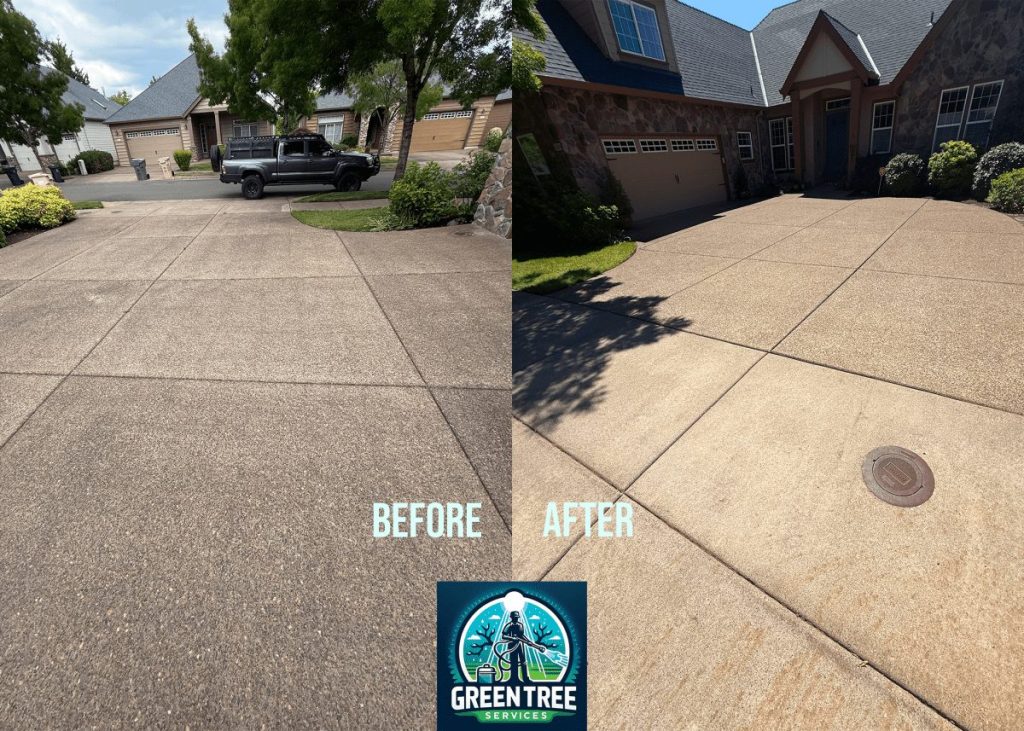
These three questions come first, so each reply stays short.
How much does exterior cleaning cost in Springfield, Oregon?
The total depends on what you add, since each surface has a posted band. Price bands begin with the two-car driveway at $150 to $250. When the roof is composition shingle, the band is $300 to $600. For a single-level house wash, budget $250 to $350. Booking two or more services at once brings 10% to 25% off.
What should a Springfield owner check on the exterior before calling?
Walk the house once and note green film, moss lines, slick steps, spilling gutters and oily slab. Every sign leads to its own method. Peeling paint and soft boards point to a repair trade instead. A table later on lists the next step for each sign.
Who answers for the wash water at a Springfield home?
The property owner answers for it, even when a hired crew does the work. The City of Eugene washing sheet says so, and it covers Springfield storm drains too. GreenTree plans the rinse route at the quote, so the water lands on soil and not in the street.
Where does wash water go in Springfield, and what does the city ask?
Springfield storm drains do not reach a treatment plant, so wash water travels to the Willamette or McKenzie River. Instead, the city page tip reads: wash on lawn, gravel or other porous surface. Runoff should go to landscaping when possible. A hired crew follows the same rule.
The City of Springfield washing page says storm drain water flows to neighborhood waterways, then to the Willamette or McKenzie. It also lists dirt, leaves, moss, grease and debris among the things that clog pipes and smother life downstream.
The same page also tells owners to block runoff with rolled towels or booms. Then they collect trapped debris and throw it out. Chemical wash water also counts as an illicit discharge under city code. A business that washes outdoors regularly may also need a DEQ wash water permit.
The City of Eugene sheet puts the duty in plain terms. Polluted discharges from any property in Eugene, Springfield or Lane County also count as illicit discharge violations. The owner answers even when a hired crew does the work.
How does Springfield weather change an exterior cleaning plan?
Wet winters build growth and a dry summer lets surfaces recover, so exterior cleaning in Springfield, Oregon follows the rain. NOAA normals for the Eugene station show 17.93 inches in winter, but only 1.94 inches in summer. Spring and autumn sit near 10.5 inches each.
The NOAA 1991 to 2020 normals come from the Eugene airport station. The National Weather Service places that station roughly nine miles northwest of Eugene city center. Read the figures as a metro guide instead of a Springfield street reading.
| Season | Normal rain | Days with rain | What it means for an exterior |
|---|---|---|---|
| Winter, December to February | 17.93 in | 52.1 | Wettest stretch, so shaded roofs, walls and steps stay damp |
| Spring, March to May | 10.42 in | 45.0 | Winter growth meets the first dry afternoons, so walls and slabs suit this window |
| Summer, June to August | 1.94 in | 13.3 | Driest stretch, because wood and concrete dry out between visits |
| Autumn, September to November | 10.54 in | 35.3 | Needles and leaves load the gutters, so autumn visits clear them early |
NOAA counts a rain day as 0.01 inch or more. The same summary puts the average last spring freeze near 17 April. It puts the first autumn freeze near 24 October.
Higher ground and exterior cleaning in Springfield
Hills around Springfield and Eugene see 50 to 70 inches in a year, says the weather service. The valley floor gets about 40 to 50. The same summary adds that the Willamette River leaves the mountains at the Eugene and Springfield area, then turns north. Roofs on higher ground may therefore stay wetter than the table suggests.
What does each sign on a Springfield exterior mean, and what comes next?
Each visible sign guides exterior cleaning in Springfield, Oregon toward one method or one trade. Growth on siding calls for a soft wash. Moss on shingles calls for hand lifting. Oily concrete takes degreaser before any rinse. Rot and peeling call for a repair trade, and cleaning waits until that repair holds.
Six signs and their next steps
| What you see | What it usually means | Next step |
|---|---|---|
| Green film on shady siding or paths | Algae, which OSU Extension says grows on shaded walls, sidewalks and patios | Soft wash on siding at under 500 PSI, or a surface cleaner on bare concrete |
| Green lines along the shingle joints | Roof moss, since the City of Eugene handout says it gets under shingles and raises them | Lift moss by hand, rinse low, and keep the pressure washer off the shingles |
| A slick green patch on a step or walk | A slip hazard, since OSU Extension asks owners to clear moss from steps and walkways | Scrape and scrub a small patch, but book a crew for a long run |
| Water spilling over the gutter in rain | A clogged gutter or downspout, so water leaves the roof in the wrong place | Gutter cleaning, then a running-water test on each spout |
| Dark oil spots on the driveway | Oil that water alone cannot lift | Apply degreaser, then pass the surface cleaner over the slab |
| Peeling paint or spongy boards | A repair problem that cleaning cannot fix | A repair trade first, then a wash once the repair holds |
The city moss fact sheet adds a habit worth copying. It also says to prune branches within 10 feet of the roof and to clear leaves and debris regularly. Sun exposure, it says, is the best deterrent for moss on roofs, so pruning matters.
What does exterior cleaning in Springfield, Oregon include?
It includes any outside surface you list, so the crew cleans from the roof down. Every material has a matching method. Roofs get hand work and a low rinse, while siding gets a soft wash. Purified water on a pole cleans the glass. Bare concrete takes the machine, and the crew covers shrubs before any rinse.
ARMA reports granule loss, then very likely premature failure, when a pressure washer cleans an asphalt shingle roof. James Hardie also advises a low-pressure hose and a soft brush for fiber cement siding. GreenTree applies a low limit to every siding type, so walls never get the strong setting.

A soft wash is a cleaning solution that lifts film, followed by a gentle rinse under 500 PSI. Top-down order means the crew completes one level before moving to the next lower one.
Springfield exterior cleaning pages for each surface
Roofs have the Springfield roof cleaning page, while gutters have the gutter page. Siding lives on the house washing page. Springfield pressure work also has its own power washing page.
Flatwork and timber have pages too. See patio cleaning, concrete cleaning, driveway cleaning, deck restoration and fence cleaning. Heavy moss has the moss removal page. Businesses can begin on the Springfield commercial page.
What does each part of a Springfield exterior cost?
Photos or a short walk settle where in the band your figure lands.
| Job | Price band | Why the figure moves |
|---|---|---|
| Two-car driveway | $150 to $250 | Slab area and oil marks |
| Driveway, walkways and patio | $200 to $350 | The amount of flatwork beside the drive |
| Patio and hardscape | $300 to $500 | Material and size |
| House washing, one level | $250 to $350 | Wall area and siding type |
| House washing, two storey | $350 to $500 | Wall height and ladder reach |
| Roof, composition shingle | $300 to $600 | Roof pitch and moss depth |
| Roof, steep or two storey | $400 to $700 | Extra ladder time and footing |
| Gutters, one storey | $150 to $200 | Length of roofline |
| Gutters, two storey | $200 to $300 | Height and access |
| Window cleaning | $150 to $700 | Pane count and storeys |
| Moss on concrete or walks | $150 to $500 | Depth of moss and area |
Bundles take 10% to 25% off, and the Oregon cost guide also lists the other bands.
How did Springfield grow, and does the neighborhood set the plan?
Springfield grew from 1.5 square miles in 1940 to more than 13 by 1998. One street can therefore hold houses from several building periods. The quote walk reads each house on its own. The neighborhood name never sets the price, because the surfaces on your list do.
Those figures come from the City of Springfield history page. It also says the population rose from 3,805 in 1940 to 51,700 by 1998.
Exterior cleaning in Springfield by plan area
The city neighborhood refinement plans page lists seven plan areas. They are Downtown, East Kelly Butte, East Main, Gateway, Glenwood, Mid-Springfield and Q Street. Ask about any Springfield address, because GreenTree prices by lot and not by area.
The Glenwood plan page also describes Glenwood as about one square mile between Eugene and downtown Springfield. While I-5 borders it on the west and south, the Willamette River borders it on the east and north. The quote walk checks shade and drainage on every lot, whether it sits near a river or not.
How does exterior cleaning in Springfield run, step by step?
Because water and grit run downhill, the sequence protects work already done.
Send your walk-around
Phone (971) 280-2861 or use the form, then add photos of what you noted.
Confirm the surfaces
The crew checks each one, then writes a separate priced line.
Plan the rinse
The crew picks a soil route, then covers the shrubs to keep water off the street.
Descend the house
Roof and gutters lead the way, and walls and glass come next.
Clean the slab last
Concrete finishes the job, so nothing above can drip onto it.
Check the work
You look over each surface before the invoice arrives.
The walk sets time for roofs, gutters and glass. Payment by cash, check or credit card closes the visit.
Who should book exterior cleaning in Springfield, and who should call a repair trade first?
Book when the surfaces are sound and growth, film or oil is the problem. Cleaning hides nothing, and it cannot repair anything. Lifted shingles, split gutter seams, rotten trim and cracked slabs all need repair, so call that trade first. The crew writes down the fault, then the wash follows after the repair holds.
Owners this plan fits in Springfield
- Owners with several dirty surfaces, since one plan and one visit fits them.
- Sellers who need a clean exterior for a listing; the pre-sale page bundles it.
- Landlords between tenants will find the property manager page useful.
Jobs for other trades
- A licensed roofer repairs shingles and re-roofs.
- Sagging gutters and new guards need a gutter contractor.
- A siding contractor installs siding, and a painter paints it.
- For fallen limbs or tree removal, call an arborist.
- An interior cleaner handles inside work, although GreenTree cleans inside window glass when booked.
What the free quote checks at a Springfield house, from the gutters to the slab
Every line changes the work, so the work sets the price.
- Roof: shingle or shake, pitch and how deep the moss runs, since depth sets the hours.
- Gutters: how long the roofline runs and what falls from trees.
- Walls: the siding material, how large the walls are, and paint wear.
- Glass: how many panes, how many floors, any skylights.
- Concrete: slab area and oil marks.
- Faults: anything rotten or cracked, because repairs come before washing.
- Storm drain: its position, since the rinse route avoids it.
- Water: a spigot that delivers steady flow.
- Access: how the truck and ladders reach each wall.
What customers say
Each review keeps its original wording, and the reviews page also has more.
These guys are awesome, great attitude and I was completely impressed with the job they did at my new house. Will definitely be using them again and again.Jeff M.
Reasonable price. Great service experience, results, and excellent communication.Macie H.
Across the river, read about exterior cleaning in Eugene. Corvallis has its own exterior cleaning page, while the statewide hub lists every city.
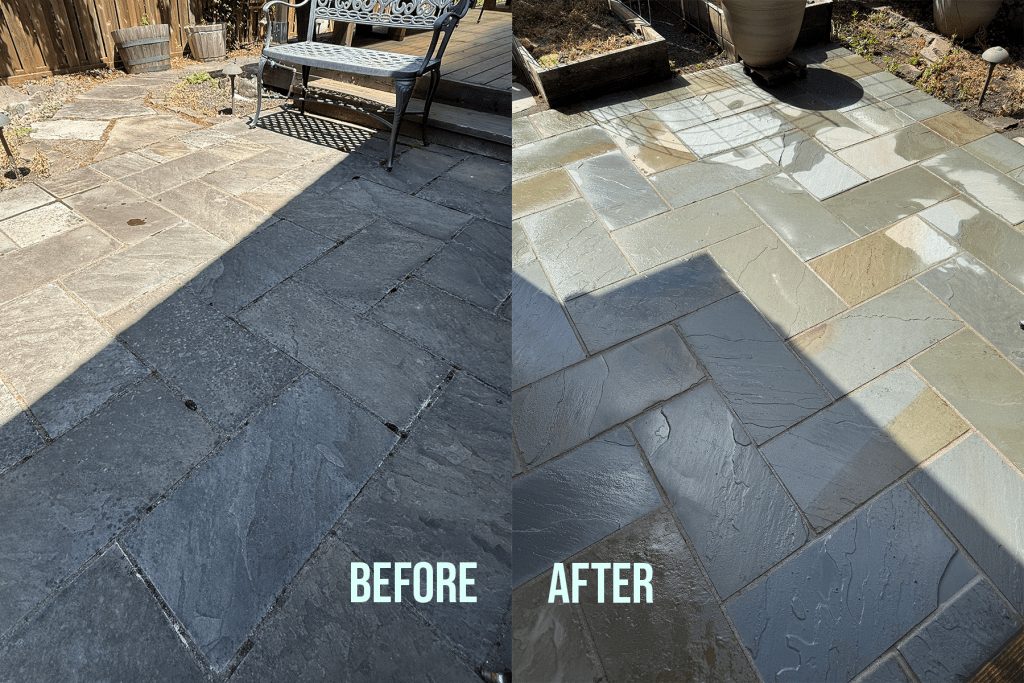
Ten plain answers on exterior cleaning for Springfield owners
Answers on timing, runoff, liability, siding and who to call.
How long does exterior cleaning in Springfield, Oregon take on a single-storey home?
The house wash needs 3 to 5 hours, and a two-car driveway needs 1 to 2. The walk assigns time to roofs, gutters and glass.
What should I photograph for a Springfield exterior quote?
Because the walk starts there, photograph the worst wall, the roof edge, the gutters and the steps. Then add one wide shot, so the quote can start before a visit.
Can I rinse my Springfield driveway toward the street?
No. The city says storm drains skip the treatment plant and end at the Willamette or McKenzie River. Rinse water belongs on soil.
Who is liable for wash water at my Springfield home?
You are. According to the City of Eugene sheet, runoff remains an owner duty whatever crew you hire. Before booking, ask where the rinse will go.
Can exterior cleaning in Springfield include roof moss?
Yes, by hand. Thick moss lifts off the shingles first, and a low rinse finishes the job. A pressure washer never touches them, because ARMA links that machine to granule loss.
Does GreenTree use a strong setting on Springfield siding?
No. Siding gets a soft wash below 500 PSI and a rinse from above. Bare slab alone takes the top setting.
Will the Springfield price change after the crew arrives?
No. You accept a written figure first, so the figure stands. If a surprise changes the scope, work pauses and the crew calls you before going on.
Which Springfield exterior jobs need another trade first?
Roof repair, gutter repair, siding installation, painting and tree work do. Tell the crew what you see, and the crew names the trade.
Can I book several Springfield exterior services in one visit?
Yes. Two or more services take 10% to 25% off. Because the discount grows with the count, bigger bundles save more.
How do I check GreenTree and its insurance before booking in Springfield?
Enter 2424331-91 in the state business registry search, then compare the entry name with your quote. Check it yourself, because the certificate lists the limits for liability and workers compensation.
Start with your walk-around
Phone or use the form, and send what you noticed. Written figures come one per surface.
GreenTree Services, 1460 NW Van Buren Ave, Corvallis, OR 97330 · (971) 280-2861 · Oregon Registry #2424331-91
Guidance on roofs and walls: ARMA and James Hardie. Also cited: City of Springfield, City of Eugene, NOAA, NWS, OSU Extension.