
Moss Removal in Salem, Oregon: Roofs, Walks, Decks and Fences, Cleared by Hand
Moss removal in Salem is slow, careful hand work, finished with a broom and a gentle rinse under 500 PSI. Shingles, in particular, stay out of reach of any pressure washer. This page also covers each surface, the roofing rules, and the signs that a roofer should look first.
Rechecked 11 October 2026 against the McNary Field weather normals and the ARMA roof moss page.
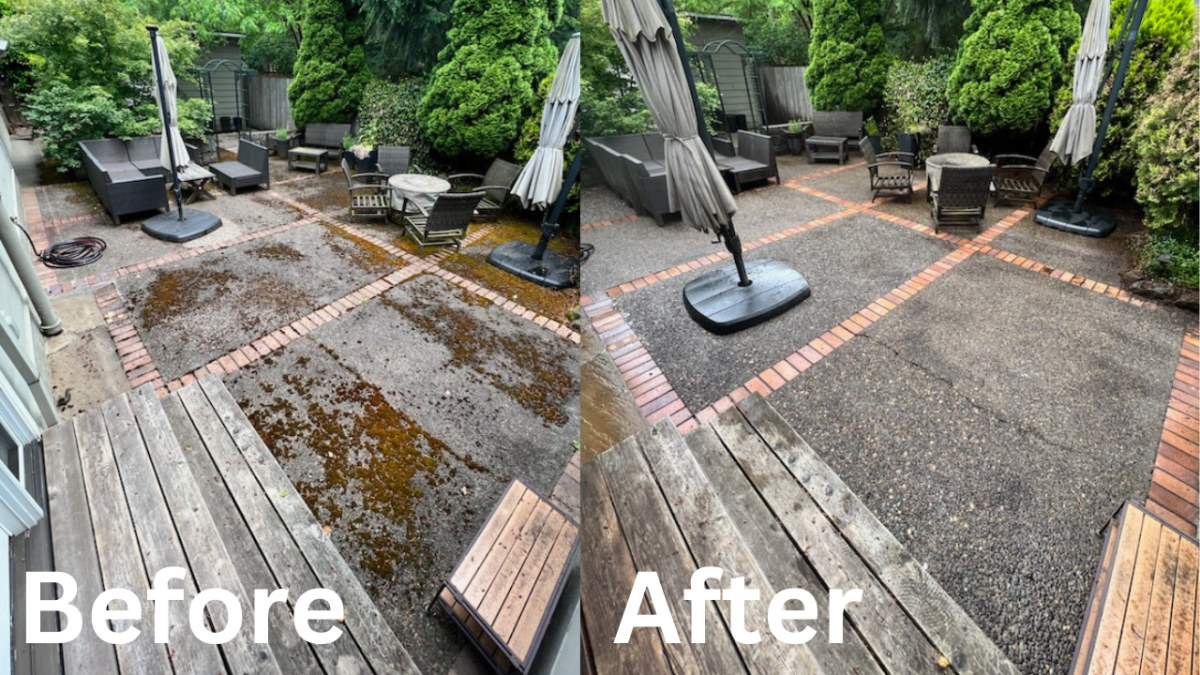
Four things Salem owners ask about moss before booking
Detail for each surface follows further down. For moss across the whole state, see the Oregon moss hub.
What does moss removal cost on a Salem property?
Mossy paths cost $150 to $500 to clear, while an asphalt shingle roof costs $300 to $600. Pitch pushes a roof to $400 to $700, and wood shakes to $500 to $900. Fences and decks also carry their own bands. You then pick from a list of lines, one per surface, so you never buy a vague bundle.
How does moss come off without a pressure washer?
By hand first, then with a broom, and finally with a gentle rinse under 500 PSI. Thick mats lift out of shingle courses and paving joints by hand. The broom then sweeps up what loosened. A low rinse carries the last loose pieces away, so the surface below keeps its granules or grain.
Will moss return once the crew has cleared it?
Yes, in time, because clearing the moss leaves the shade and the 148 days of rain a year at McNary Field exactly as they were. Moss must have a moist environment to survive, in the words of the asphalt roofing makers group. The darkest, dampest corners of a lot therefore green up again first.
When should a roofer look at a mossy Salem roof first?
When shingle edges have lifted or curled, when shingles are missing, or when stains show on a ceiling inside. Heavy moss can do that damage over the years, and a cleaning visit cannot undo it. Those faults need a licensed roofer. Removal then follows once the roof is sound again.
Where does moss grow on a Salem property, and how does each spot get cleared?
The table below covers 6 surfaces, from asphalt shingle and cedar shake roofs to concrete walks, brick or stone steps, decks and fences. Moss grows wherever water lingers and sun is short, so one lot can hold it in several places.
| Where the moss sits | How it comes off | Why that way |
|---|---|---|
| Asphalt shingle roof | Lifted out by hand, swept, then rinsed gently | Granules come off under a jet |
| Cedar shake roof | Lifted out by hand, with an even softer rinse | Wet wood is soft and porous |
| Concrete walks and paths | Mat pulled up, then a rotating cleaner on the bare slab | Sound concrete takes pressure evenly |
| Brick or stone steps | Hand lifting and a low rinse | Joints and soft faces wear under a jet |
| Wood decks | Hand or brush work, then low pressure along the grain | Crossing the grain raises fibres |
| Wood fences | Low water, run lengthwise on the pickets | Thin boards splinter under force |
Each row follows one rule: use the least force that does the job. As a result, the surface under the moss comes out intact, not just clean.
Why do Salem roofs, walks and fences grow so much moss?
McNary Field logs rain on 134.4 days between September and May, against 13.5 in summer, so Salem surfaces rarely dry out for long in the wet season. Shade then decides which ones stay damp longest: north slopes, spots under trees and boards near soil.
| Season at Salem McNary Field | Days with 0.01 inch of rain or more | Normal rain |
|---|---|---|
| Winter, December to February | 53.0 | 17.59 inches |
| Spring, March to May | 44.8 | 9.72 inches |
| Summer, June to August | 13.5 | 1.89 inches |
| Autumn, September to November | 36.6 | 10.88 inches |
The NOAA seasonal normals for McNary Field show rain on 134.4 days between September and May. Summer, by contrast, brings only 13.5 wet days, so surfaces dry fast. Lows there also reach 32 degrees F or colder on 49.4 nights in a normal year.
North slopes, tree litter and the slow drying that moss likes
Rain falls on the whole lot, yet shade decides how long each surface stays wet. In North America, ARMA writes, moss favours roof slopes that face north. Sun reaches those slopes less, so water sits on them for longer after each shower.
Trees add to it in two ways, according to the same page. Branches cut the light, and the needles and leaves they shed trap water on the shingles. ARMA even calls that litter a food source for moss.
On the ground, the same pattern repeats. For example, a path along the north wall stays wet long after a storm. A deck under a big tree does too. These are therefore the first places the quote marks for moss.
What does ARMA say about moss on asphalt shingle roofs?
ARMA is the trade group for asphalt roofing makers, so its page is the plainest rulebook for shingles.
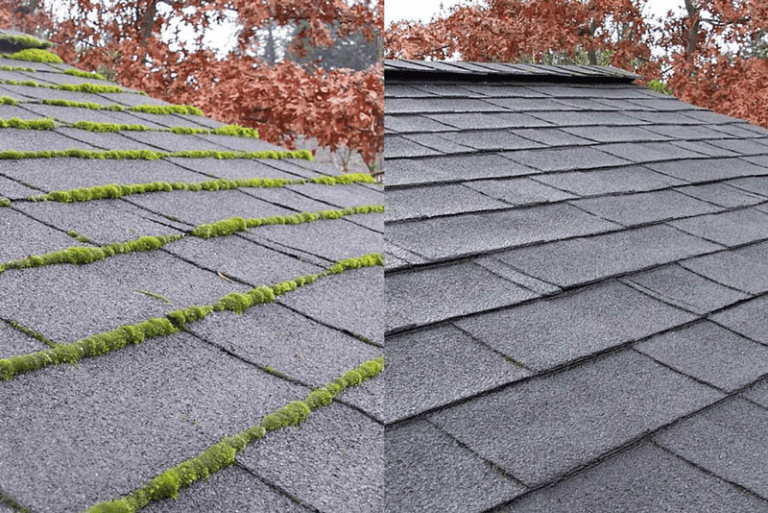
No pressure washer, ever, on asphalt shingles, since the jet strips granules and very likely ends the roof early. Moss itself, left alone, can raise or curl the exposed shingle edges, so wind can tear them off. Worse, ARMA warns of moisture damage to the roof deck, or even leaks, in severe cases.
Read in full, the ARMA algae and moss page gives four points that shape a Salem roof visit:
- No pressure washer on shingles. Our roof work is therefore hand work, with water kept below 500 PSI.
- Moss needs moisture. The slopes that see least sun are where the quote looks hardest.
- Moss damages the roof over time. Waiting years, in other words, lets small problems grow.
- Debris should come off by a non-abrasive method. ARMA names a leaf blower as one example.
Cutting back overhanging limbs also appears in the ARMA advice, for light and for less litter. Any such cutting, however, is a job for a tree service.
When should a Salem owner call a licensed roofer instead of booking moss removal?
Even a gentle rinse under 500 PSI would push water through a missing shingle, so the signs below send a Salem roof to a licensed roofer first. A cleaning crew clears moss from a sound roof, but it does not repair one. The crew points these signs out from the ground, before anyone climbs.
- Shingle edges that have lifted or curled. ARMA links this to moss, and it raises the risk of blow-off.
- Missing or cracked shingles. A gap lets water straight through, so a rinse would only make it worse.
- Brown marks on the upstairs ceiling or attic boards. These suggest a leak, which needs a roofer to trace it.
- A deck that feels soft underfoot. Nobody from a cleaning crew should walk on it.
- Bare patches with few granules left. These point to an ageing roof, so a roofer should judge its remaining life.
We point these out from the ground, before anyone climbs, because a damaged roof is unsafe to walk. If one shows, the quote pauses until a licensed roofer has seen the roof. Moss removal can then follow on a sound surface.
How does moss removal work on Salem walks, decks and fences?
Ground-level moss is mostly a footing and looks problem. On wood, however, it also wears the boards.
Walks, paths and steps
Wet moss on a shaded path can turn slick, above all from autumn to spring. The crew first lifts the thick mat by hand. Once the slab is bare, a spinning surface cleaner passes over it, so no wand stripes appear. Brick and stone steps, by contrast, get only a low rinse, since their joints wear quickly under force.
Wood decks
Deck boards hold moss in their gaps and along shaded edges. Hand or brush work therefore frees the moss first. Low pressure then follows the grain, because crossing it raises soft fibres. The Salem deck restoration page covers staining afterward.
Wood fences
Fences catch moss low down, because soil and plants keep the bottom boards damp. Water follows each board from end to end, at a low setting. Both faces join only when you book them, since a neighbour may own the far side. The Salem fence cleaning page has more on that.
What does moss removal in Salem cost for each surface?
Booking several surfaces together trims 10% to 25% off the total, yet each surface still keeps its own band below. A walkway job and a roof job never share one vague figure. Roofs carry the widest spread, because pitch and moss depth vary so much.
| Surface | Price | What moves the figure |
|---|---|---|
| Moss on concrete walks and paths | $150 to $500 | Square footage and mat depth |
| Composition shingle roof | $300 to $600 | Size of the roof and its valleys |
| Steep or two-storey roof | $400 to $700 | Pitch, height and setup time |
| Cedar shake roof | $500 to $900 | Shake condition, since wood needs the gentlest pass |
| Wood fence, standard six-foot run | $150 to $400 | Run length, and one face or two |
| Deck up to 300 sq ft | $150 to $250 | Boards, rails and steps |
| Deck from 300 to 600 sq ft | $250 to $450 | Balusters and stair count |
| Gutters below a mossy roof, one storey | $150 to $200 | Run length and how much moss fell in |
| Gutters below a mossy roof, two storeys | $200 to $300 | Height and access |
Roofs carry the widest range, since pitch and moss depth vary so much. A roof and its gutters also often go together, because loose moss ends up in the troughs. Book several surfaces together, and the bundle discount then trims 10% to 25% off the total.
What does moss removal in Salem include, and what stays out of it?
The visit clears moss from the surfaces you book, using hands, a broom and a rinse under 500 PSI on roofs. It is a removal service, nothing more: no repairs, no tree pruning and no promise about how long a surface stays clear. The lists below show both sides.
Included on the day:
- Hand removal of thick moss from shingle courses, joints and board gaps.
- Broom work once the thick mats are out.
- A rinse under 500 PSI on roofs, and low pressure along the grain on wood.
- A surface cleaner on bare concrete once the moss mat is off.
- Gutters cleared by hand below any roof we cleaned, if you booked them.
Left out on purpose:
- Any promise about how long a roof or path stays clear.
- Shingle and roof repairs, for a licensed roofer to handle.
- Tree pruning, which instead belongs to a tree service.
Loose moss and grit, moreover, stay out of the street drain, and rinse water soaks into soil. State wash guidance from Oregon DEQ keeps anything knocked loose out of storm sewers and streams.
Who should book moss removal in Salem, and who should not?
Moss removal suits sound surfaces with a growth problem, so the lists below sort the cases first.
A good fit:
- A roof with moss in the joints but flat, intact shingles.
- Shaded paths and steps that, in the wet months, turn slick.
- A deck or fence with green on the boards but, so far, no rot.
- Owners getting a house ready to list, who want the roof looking cared for.
Not a fit yet:
- A roof already shedding or curling shingles, since that is roofer territory.
- Rotten deck boards or leaning fence posts, which go to a carpenter.
- Anyone who wants a spray product applied, which this page does not describe.
Moss removal in Salem, step by step, from the photos to the gutters
The roof check comes before any climb, and the gutters come last, since moss falls into them.
Send photos and the surfaces
Call (971) 280-2861 or use the form, and say where the moss sits.
Look at the roof from the ground
We check shingle edges and shade before anyone climbs, then price each surface.
Lift the moss by hand
Thick mats come away by hand, and a broom then clears what loosened.
Rinse under 500 PSI
A gentle rinse carries loose bits down, and wood gets low pressure along the grain.
Empty the gutters, then walk
We empty the gutters by hand, and then we walk the lot with you.
The number of surfaces booked sets the length of the visit. A roof with gutters, for example, takes longer than a single path.
What the free quote checks, and when does it pause for a roofer?
The free quote takes 6 readings, from shingle edges and moss depth to where the gutters drain. Lifted or curled edges pause the roof job until a roofer has looked, while the other 5 readings shape the price of each surface.
- Shingle edges. Lifted or curled edges pause the roof job for a roofer.
- Moss depth. A thin film, for instance, takes far less time than a thick mat.
- Roof type and pitch. Composition, cedar and steep roofs each sit in their own band.
- Shade and trees. North planes and branches overhead usually hold the most moss, so they take longest.
- Ground surfaces. Concrete, brick, stone and wood also each get their own method.
- Gutters and drains. Where loose moss lands, and where the rinse water runs.
Which other Salem pages go deeper on a single surface?
Moss touches almost every outdoor surface, so several Salem pages share the topic. The roof cleaning page covers the whole roof, plane by plane and through the frost months, while the concrete, patio, gutter and soft washing pages each take one surface further than this page can.
The Salem roof cleaning page goes further on roof planes and frost. Paths and slabs have the Salem concrete cleaning page, and patios the Salem patio page. For gutters below a mossy roof, see gutter cleaning in Salem. Low pressure in general gets its own explainer on the soft washing page.
Questions Salem owners ask about moss removal, from price to timing
Short answers on price, method, roofers and timing.
How much does moss removal cost in Salem?
Paths and walks with moss sit in a $150 to $500 band, set by size and mat depth. For roofs, asphalt shingle is $300 to $600, steep is $400 to $700, and shake is $500 to $900. Fences and decks have their own bands, so the written quote lists each surface on a separate line.
Do you pressure wash moss off Salem roofs?
No, never, and even the rinse stays under 500 PSI. A jet on asphalt shingles costs them granules, according to the shingle makers in ARMA. On a Salem roof, the moss instead comes out by hand, and a broom gathers the loose bits. Gentle water then flushes the remnants into the troughs.
Will the moss grow back after removal?
It can, because removal leaves the conditions unchanged, and Salem sees rain on roughly 148 days a year at McNary Field. Moss needs moisture to survive. Shade from trees and north-facing slopes keeps surfaces damp longer, so those spots green up first again.
When should a roofer look at my Salem roof before moss removal?
Call a licensed roofer first if shingle edges curl, if shingles are missing, or if stains show indoors. ARMA warns that moss can lift shingle edges and even cause leaks. Removal clears the moss, while repairs belong to the roofer.
Is moss on a Salem walkway a slip risk?
Wet moss on concrete can be slick underfoot, above all on shaded paths and steps through a winter with 53 rainy days at McNary Field. Removal starts with lifting the mat by hand. Bare concrete then gets a surface cleaner, which leaves an even finish without stripes from a bare wand.
Can you remove moss from a wood deck or fence?
Yes, with low pressure along the grain, because soft wood fuzzes when a jet crosses it. A brush or bare hands free the thick clumps beforehand. Fence runs of normal height price at $150 to $400. A compact deck, however, comes in lower, at $150 to $250 below 300 square feet.
Does the visit include a spray product for moss?
No: the visit is removal only, with hands, a broom and a gentle rinse under 500 PSI. Nor does it say how many months a cleared surface will stay green-free. Products sprayed onto a roof are a separate matter, and Oregon licenses the people who apply them for hire.
When is the best time of year to book moss removal in Salem?
Late spring and early autumn suit roofs and shaded walks, because surfaces dry between showers, and July and August average only 2.3 and 3.2 wet days at McNary Field. Winter brings rain on 53 days in three months, which makes roofs slippery and slows the work.
Ready to price the moss on your Salem property?
Photos from the ground are plenty to start with. Next, the walk-round checks the roof edges and writes one line per surface.
GreenTree Services, 1460 NW Van Buren Ave, Corvallis, OR 97330 · (971) 280-2861 · Oregon Registry #2424331-91
Facts on this page come from: ARMA algae and moss. NOAA McNary seasonal normals. NOAA monthly file, USW00024232. Oregon DEQ wash water. Verify Registry #2424331-91.