
Moss Removal in Milwaukie, Oregon: What to Do Yourself, What to Hand Off
Moss removal in Milwaukie, Oregon can be a weekend brush job, or a ladder job for a crew. The surface and the height decide which. This page sorts the two, using OSU Extension advice. When a crew helps, GreenTree lifts the moss by hand, rinses at low pressure and prices each surface in writing.
Behind this page, all opened 7 October 2026: Milwaukie city pages, NOAA, Oregon DEQ, OSU Extension, ARMA and OSHA.
Milwaukie moss in brief: brush, crew or both
For moss removal in Milwaukie, Oregon, three answers settle most of it. The table after them goes surface by surface.
Is moss removal on a Milwaukie walk or patio a do-it-yourself job?
Yes, on flat ground it often is, because moss has no roots and lifts easily. OSU Extension suggests sweeping first, then a hose, plus a stiff-bristle brush or a wide flat scraper for stubborn patches. It also says pressure washing works on patios, decks and sidewalks. Shade and sprinklers, however, bring the moss back.
When does moss removal in Milwaukie need a crew instead of a brush?
A crew makes sense when moss sits on a roof, a tall wall or a large area, and OSU Extension calls for belts and lines once eaves top 16 feet. On roofs, though, OSU Extension says to stay off and hire a roofing professional. Even on the ground, it says, scraping and scrubbing a patio takes effort.
What does GreenTree charge for moss removal in Milwaukie?
The surface is what sets the charge, and each one has a published band. Concrete paving with moss, walk or driveway, is a $299 to $500 job. Patios of hardscape also follow the patio band of $300 to $500. Roofs start at $300 to $600 for composition shingle, while steep or two-story roofs run $400 to $700.
Which moss removal jobs in Milwaukie, Oregon suit a homeowner, and which suit a crew?
Read across each row. The middle column gives the sources view for owners, while the next shows where hired hands add something.
| Surface | What the sources suggest | Where a crew adds value | GreenTree band |
|---|---|---|---|
| Concrete walk or driveway | Sweep, then brush or scrape | Large areas, machine finish | $299 to $500 |
| Hardscape patio | Pressure washing works here | Lower setting for joints | $300 to $500 |
| Deck boards or steps | Remove moss where slippery | Gentle pressure for wood | No published band |
| Rock wall or landscape stone | Rarely a problem, says OSU Extension | Caps and joints by hand | No published band |
| Asphalt shingle roof | Scrape gently; avoid climbing | Hands, then a low rinse | $300 to $600 |
| Gutters under the roof | ARMA: keep them clean | Hand scoop, flow test | $299 |
That gutter figure covers one story, and for two stories the band is $299. Both include a flow test at each downspout.
A safe weekend method for flat paving
The OSU Extension answer on pavement moss sets out a plain routine. First, sweep dirt and debris with a stiff broom, and cover plants nearby. Next, spray the moss off with a garden hose. If a patch holds on, scrub it with a stiff-bristle brush or lift it with a wide, flat scraper. Moss has no roots, it notes, so the green carpets lift easily.
The OSU Extension moss guide adds a dull blade, such as a putty knife, as another option. It also warns that runoff carrying moss-control products should never reach storm drains or waterways. If you use one, keep it well away from the street.
Where the ladder changes the answer
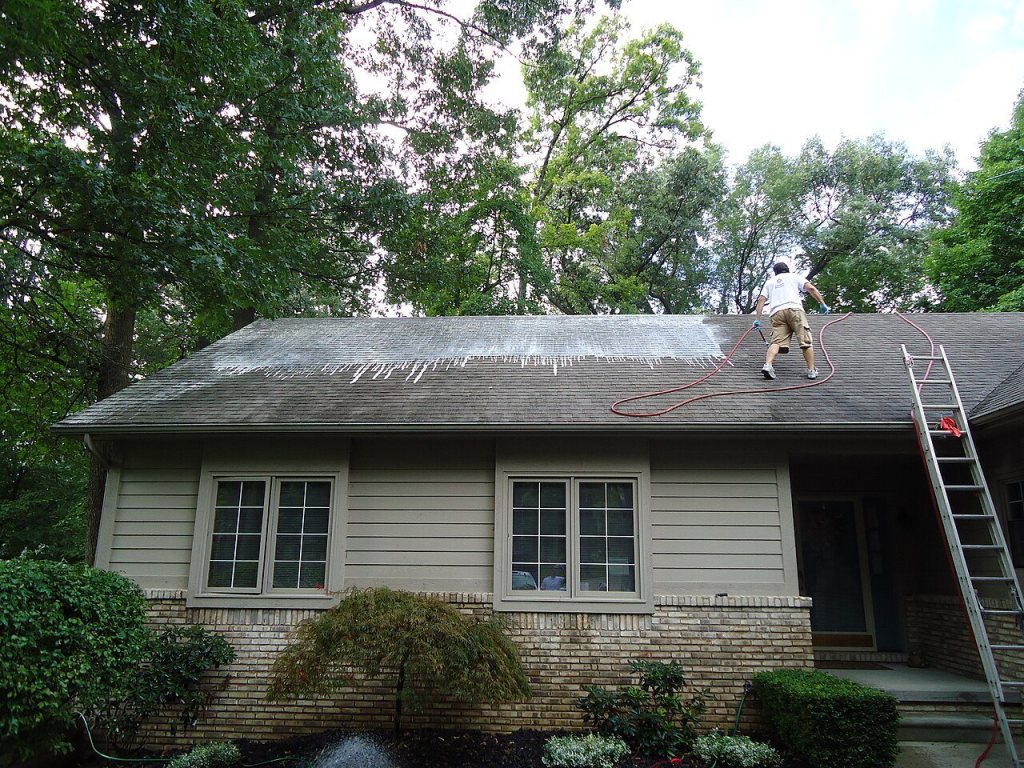
Roofs are another matter. The moss guide is blunt here: hire a roofing professional instead of climbing. It also notes that asphalt shingles damage easily, so any scraping must stay gentle. Besides, pressure washing is not advised for roofs, it says, because it damages shingles.
For owners who still go up, the OSU Extension roof moss article lists precautions. First, the ladder stands on stable ground and reaches 3 feet past the roof edge. After that, a rope and bucket lift the tools instead of your hands. Finally, it adds belts and lines if eaves top 16 feet, the pitch is steep, or work nears an edge. The OSHA ladder standard also adds a setback rule: the foot sits out about a quarter of the working length.
Who keeps a Milwaukie sidewalk clear, and how high must branches hang?
The adjoining owner keeps the sidewalk safe, while branches must clear it by 8 feet. The city expects owners to keep that sidewalk in good repair, free of litter, debris, ice and snow. Over the street itself, by comparison, limbs must clear 12 feet. Moss is not named, yet OSU Extension calls sidewalk moss a slipping hazard.
The sidewalk duty, for one thing, appears in a city project FAQ on sidewalk ownership and maintenance. It says, in fact, that property owners maintain the sidewalk adjoining their land, in good repair and a safe condition. Owners must also keep it free of litter, debris, ice and snow.
The branch heights then come from Milwaukie Municipal Code 12.12.010, quoted on the city code compliance FAQ. In short, owners or occupants beside a street or sidewalk must trim overhanging shrubs and trees. They must also remove any growth that creates an unreasonable risk of harm. None of that trimming falls to GreenTree, since we do no tree work.
After all, shade from those same branches feeds moss on the walk below. That is why OSU Extension suggests pruning to let more sun reach the pavement. It also suggests adjusting lawn sprinklers so they stop wetting the paving.
How wet does a Milwaukie winter get, going by a nearby NOAA station?
December alone brings 7.35 inches of rain over 19.7 wet days at the KGW-TV station, the nearest NOAA record. That station sits in Portland, so read it as area context. Days with half an inch or more reach 5.3 in December, and 28.5 such soaking days occur in a year.
Because station USC00356749 lies in Portland, not Milwaukie, its table is context for the area. Its rows reproduce the NOAA 1991 to 2020 monthly normals, file PORTLAND KGW-TV. Also, the yearly soaking-day count is in the annual normals file.
| Month, KGW-TV station | Precipitation, inches | Days at 0.01 inch or more | Days at 0.50 inch or more |
|---|---|---|---|
| October | 3.96 | 12.8 | 2.7 |
| November | 6.58 | 18.6 | 4.2 |
| December | 7.35 | 19.7 | 5.3 |
| January | 6.36 | 19.5 | 4.7 |
| February | 4.74 | 15.6 | 2.8 |
| March | 4.83 | 17.7 | 3.6 |
| April | 3.63 | 16.9 | 2.0 |
| July, for contrast | 0.43 | 3.1 | 0.1 |
In fact, December is the wettest month on the record, with 7.35 inches. July, by contrast, logs just 0.43 inches over 3.1 wet days. In dry months, OSU Extension adds, dried-out moss on a roof can ignite from embers.
Milwaukie moss removal prices, from walkway to ridge
For moss removal in Milwaukie, Oregon, no row is a special rate, because each one is a published GreenTree band. The written quote then sets an exact figure for each line.
| Where the moss is | Published band | Main price driver |
|---|---|---|
| Concrete walks and driveways | $299 to $500 | Total area |
| Hardscape patio | $300 to $500 | Patio size and joints |
| Composition roof | $300 to $600 | Roof area, moss depth |
| Steep roof or two stories | $400 to $700 | Ladder work at height |
| Cedar shake roof | $500 to $900 | Slow, soft-wood passes |
| One-story gutters | $299 | Run length |
| Two-story gutters | $299 | Height |
| Walls, steps and decks | No published band | Separate line |
| Three or more services | 10% to 25% off | Count of services |
For the roof in depth, see the Milwaukie roof cleaning page. If you need siding or window prices too, the Oregon cost guide lists them.
What does moss removal in Milwaukie include at ground level and up top?
Every surface named on your quote, from front walk to a ridge rinsed under 500 PSI, is part of moss removal in Milwaukie, Oregon. At ground level that can mean walks, driveways, patios, steps and block walls. Up top, it means roof planes and, if booked, the gutters. The crew also protects planting and keeps loose moss away from drains.
On walks, walls and steps
- Walks and driveways: a dry sweep, hand work on thick patches, then the surface cleaner on bare concrete.
- Patios and pavers: hand work, then a lower setting so joint sand stays put.
- Block walls: hands clear caps and joints, and then light pressure follows.
- Steps and decks: the wood gets a softer setting once hands have cleared the moss.
Up top
- Roof planes: hands free the moss from each joint, top to bottom.
- Rinse limit: 500 PSI at most on a roof, and no pressure washer on shingles.
- Gutters: if you add them, the crew scoops out fallen moss and flow tests every downspout.
- Notes: whenever tabs have lifted, the photo notes say so for a roofer.
How moss removal in Milwaukie runs, from first photo to final rinse
Seven stages make up moss removal in Milwaukie, Oregon, and they run in this order. Step four comes from Oregon DEQ guidance, which asks for a dry sweep when paving carries excessive debris.
Describe the surfaces and send pictures.
Use the form or call (971) 280-2861. After that, list each mossy surface, and add a wide photo of each one.
Check the figure on every line.
Prices sit surface by surface. After your approval, none of them moves on the day unless you add work.
Shield the planting near the work.
Shrubs and beds beside the work get water, and then a cover, before anyone starts.
Sweep the paving dry first.
Loose moss and grit come off with a broom, so the rinse later carries less toward any drain.
Strip cushions from joints and caps.
Then hands take the thick moss out of walk seams, wall caps and shingle joints.
Rinse, then finish bare concrete.
Roof water stays below 500 PSI. Afterwards, the rotating surface cleaner finishes bare concrete, while stone and wood keep gentle settings.
Check each surface against its photo.
You compare the before and after views together, and any repair concern goes into the notes.
Hand work keeps shingle granules on the roof. It also leaves sand in the paver joints.
Where should moss rinse water go in a city with 197 drywells?
Onto your lawn or planting beds after a dry sweep, since Milwaukie counts 197 drywells in its stormwater system. Catch basins, pipes and ditches complete that system. Its stated aim, under its Clean Water Act permit, is less pollution in streams and groundwater. Loose moss therefore goes into bags, not drains.
The figures come from the city stormwater division page. It also describes a street sweeping cycle of every eight days, run to meet the city stormwater permit. So a broom on your own paving follows the same idea at a smaller scale.
Oregon DEQ washing guidance backs that order. Section 2.1 says paving with excessive debris should be dry swept or blown before any water-only wash.
Who should hand Milwaukie moss to GreenTree, and who needs a roofer or tree service?
Of the 9 cases below, 4 suit GreenTree: a sound surface where moss is the only issue. The other 5 need a check or another trade first, such as a licensed roofer for curling tabs or a tree service for branches below 8 feet. Moss removal in Milwaukie, Oregon starts once the surface itself is sound.
Hand it to GreenTree if you have
- A shingle roof with moss in the joints but no curled or missing tabs.
- Paving gone green and slick, with every slab still level and whole.
- A block wall with green caps that still stands true.
- A patio too large to scrape by hand over a weekend.
Fix these before any moss work
- Tabs missing or curling up: a licensed roofer, not a cleaner, should see the roof first.
- A leaning or cracked wall: ask us first, since cleaning cannot fix a structure.
- Soft deck boards: GreenTree fixes the rot before any wash.
- Branches below 8 feet over the walk: because city code sets that limit, a tree service trims them.
- Gutters that sag: repair is outside our work, so a gutter contractor goes first.
Seven things a Milwaukie moss quote looks at
In short, this is what the free quote checks, item by item. Photos often cover them all, although a steep or large roof may need a look in person.
- Which surfaces: walks, walls, patios, steps or roof, since each takes its own method.
- How thick the moss sits: a light film goes fast, while a deep mat takes longer.
- Size: since area drives it, paving falls somewhere inside the $299 to $500 band.
- Height: if there is a second story or a steep pitch, the roof moves into the higher band.
- Overhead shade: branches show where moss will return, and whether a tree service should trim first.
- Drains and drywells nearby: because rinse water must avoid them, they shape the route.
- Water and access: an outdoor tap within hose reach, as well as space for the truck.
Diane M. and Barbara R., unedited
Neither review names a city. Read more on our reviews page.
My driveway and back patio had not been cleaned in years. Both were so bad they looked black. By the time Green Tree was done both looked almost brand new. I would highly recommend and will use them again in the future.Diane M.
Great service. Very efficient and polite.Barbara R.
Milwaukie roof and pressure washing pages, plus nearby moss pages
The roof has its own Milwaukie page, and so do driveways and siding. Moss across the rest of the state is the subject of the Oregon moss removal guide.
For a Milwaukie address
Nearby and general
Milwaukie moss removal: ten questions from brush to drywell
Tools, ladders, sidewalks, walls, drywells, zinc strips and cost.
Which tools does OSU Extension suggest for moss on a Milwaukie driveway?
Start with a stiff broom to sweep off loose dirt, then spray the moss with a garden hose. If a patch clings, OSU Extension suggests scrubbing with a stiff-bristle brush or lifting it with a flat scraper. It also suggests covering plants nearby.
Should I climb onto my Milwaukie roof to scrape off moss?
OSU Extension advises against climbing and suggests hiring a professional, and anyone who goes ahead needs a ladder reaching 3 feet past the roofline. Tools then travel up in a bucket on a rope. Shingles should never see a pressure washer either, per ARMA.
Does a Milwaukie owner have to keep the sidewalk clear?
Yes: the city says owners keep the adjoining sidewalk in good repair and a safe condition, with branches trimmed to clear it by 8 feet. It also expects it free of litter, debris, ice and snow. Moss is not named, but OSU Extension calls sidewalk moss a slipping hazard.
How low may branches hang over a Milwaukie sidewalk?
No lower than 8 feet, under Milwaukie Municipal Code 12.12.010. Over the rest of a street, the limit is 12 feet. A tree service, not GreenTree, does that trimming. Low limbs also shade the walk and feed its moss, which is why OSU Extension suggests pruning to let more sun reach the pavement.
Can moss removal in Milwaukie include a block retaining wall?
Yes. Hands clear the caps and joints, and then light pressure finishes the block. With no published band for walls, the quote prices yours on a line of its own. OSU Extension notes that moss on rock walls and landscape features is rarely a problem. On stone, this is often a looks choice.
Will rinse water from moss removal in Milwaukie reach a drywell?
It should not, because the rinse goes onto your lawn or beds after a dry sweep, away from the 197 drywells the city lists. Milwaukie manages that stormwater system to limit pollution reaching groundwater. Loose moss goes into bags rather than toward a drain.
How much does moss removal in Milwaukie cost for a walk and a driveway?
Moss on a concrete walk plus driveway lands in the $299 to $500 band. Where the figure lands, though, depends on area and how deep the moss sits. The quote then splits walk and driveway into two lines. A light film goes fast, while a deep mat takes longer.
Do zinc strips stop moss on a Milwaukie roof?
According to OSU Extension, zinc or copper strips will not eliminate moss. It also warns that nailed strips could leak if poorly installed. Fitting strips to a roof already in place is not something ARMA recommends, because exposed nails can leak. GreenTree does not install them.
Does GreenTree clear moss from a Milwaukie lawn?
Ask us first, since our moss work covers 5 hard surfaces: walks, walls, steps, patios and roofs. Moss in grass is a turf and soil question, so a lawn-care plan usually fits it better. The quote can still cover any walk or patio beside the lawn.
Which weather station sits behind the Milwaukie rain table?
It is NOAA station USC00356749, filed under the name PORTLAND KGW-TV. It sits in Portland, outside Milwaukie, so read its figures as nearby context rather than a Milwaukie reading. Its 1991 to 2020 monthly normals supply every row of the rain table, October through April plus July.
Rather not climb? Send us the photos
A wide photo of each mossy surface is enough. The price then comes back in writing, one line per surface.
GreenTree Services, 1460 NW Van Buren Ave, Corvallis, OR 97330 · (971) 280-2861 · Oregon Registry #2424331-91
Sources: Milwaukie sidewalk FAQ. Milwaukie code compliance FAQ. Milwaukie stormwater division. NOAA KGW-TV monthly. NOAA KGW-TV annual. Oregon DEQ wash water. OSU Extension pavement moss. OSHA ladders. OSU Extension moss guide. ARMA roofing. OSU Extension roof safety. Oregon registry.